Family and College Class Visit the Netherlands
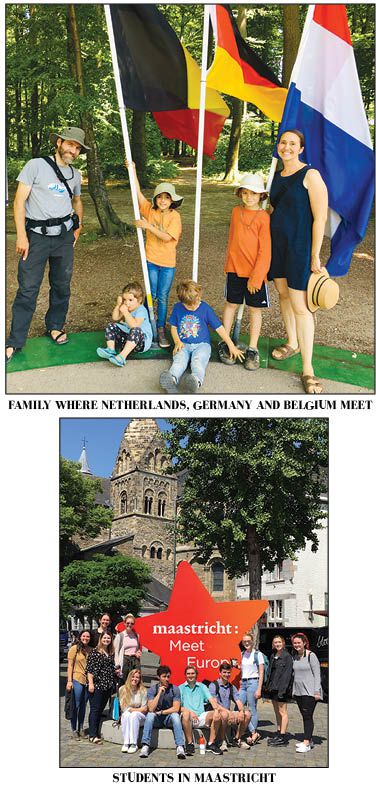
(Editor’s Note: Jehan El-Jourbagy is a local resident who teaches business law and ethics at Georgia College. This summer, she led a month-long summer abroad program in the Netherlands and took along her husband and four small children.)
On a sunny Georgia day, we packed up the van and headed to the airport. Packing for a family of six required some research and careful planning. I read up on websites that talked about flying with children, and still, I was unprepared.
During our trans-oceanic flight, I learned that children get really cold and the thin blankets do not cut it. I learned that to stave off whining and complaints, more snacks are required. Either my children handle flying well, or the lollipops on take-off and landing helped them with potential pressure/ear issues.
We arrived at Amsterdam’s airport on a Wednesday at about 8 in the morning, their time. We followed the signs to the taxi stand, but could not figure out where our taxi was. My phone was not working as expected, so we had to rely on the man at the taxi stand who first gave us directions and then walked us personally to where our taxi was waiting.
Here is the first difference I observed in the Netherlands: we were met by a cacophony of languages, and I felt chagrined knowing that almost everyone speaks at least two (if not three or four) languages fluently when I speak just one.
The taxi took us to a small rental car agency in the city center where we first laid eyes on our car, a vehicle billed as a seven-seater. Which leads me to major difference number two: everything is smaller. Everything. My husband immediately eyeballed the trunk (honestly, in America, I doubt we would even call the rear of this vehicle a trunk) and said, “It isn’t going to fit.”
He was referring to our luggage. I was doubtful too, but in my hopefulness to get going and get rested, I, along with the rental car agent, starting finagling seat configurations and stuffing luggage every possible place it could go. And you know what? It fit. It was ugly, but it fit.
And then, difference number three: almost every car is a manual. Thankfully, my father taught me how to drive a stick, but it had been about 10 years since I had last driven one. And now I was about to take to the streets of Amsterdam quite rusty and jetlagged.
I managed to drive about two and half hours south, puzzling over signs (really, I should have at least watched a YouTube video about traffic signs in the Netherlands) and finally pulling into the main square in Maastricht, where I stopped to plug in the directions to our rental house only to be immediately met by a police officer knocking at my window. Apparently, I had made an illegal left turn. Thankfully, he must have had pity on me and let me off with a stern warning.
We got to our house, which was in a small town in Belgium on a canal and next to a bridge. The house included a fenced-in yard and trampoline – perfect for our children. We spent the first few days resting and meeting with family members.
My mother is from the south of the Netherlands, a province called Limburg, and she is one of five children. While there, I, along with my brother, his wife, and my family, met all of my aunts and uncles and their spouses and six out of ten cousins and their families. While visiting with them, we ate lots of open-faced pie, which they call vlai.
Before my twelve students arrived, I scoped out my commute to Maastricht, their residence hall and the surrounding area. The students arrived on Sunday, and I walked them to dinner at a Dutch restaurant so the students could sample staples such as croquettes (fried meat balls), fries with [truffle!] mayonnaise, and bitterballen (mini-fried meat balls). Yes, they like to fry things. Hey, something we have in common!
Monday through Thursday, I worked eight to 14 hour days with my Georgia College business students, focusing on international environmental laws and sustainability and corporate leadership. Once a week, we met in class in Maastricht, and the other days, we travelled the surrounding countryside, visiting small businesses, meeting corporate leaders, touring, and focusing on class content.
Students visited places such as the Boekhandel Dominicanen, a bookstore in a 13th century cathedral in Maastricht, the Peace Palace in The Hague, home to the International Court of Justice, and the Liege Airport in Belgium, a major cargo hub in Europe.
Also, Rotterdam, Europe’s largest port, Brightlands, an industrial and chemical campus, including ammonia, fertilizer and petrochemical plants, De Ceuval in Amsterdam, a business incubator demonstrating large-scale sustainability initiatives, and Interface’s Awarehouse and factory floor, a Georgia carpet tile company that aspires to zero waste in the industrial process and seeks to combat climate change.
Students also toured the Lindt Chocolate museum in Cologne, Germany, chocolatiers in Brussels, a boutique hotel in a castle in the Netherlands, and the Edam Cheese Festival.
Monday through Thursday, my husband, alone with four children, ventured out into the neighborhood, taking walks along the canal, hiking up into the hills, biking on the trails and extensive bike paths, and generally exploring the region.
In regards to bike paths, the entire country of the Netherlands is connected by bike paths. Except for interstates (or motorways, as they call them), every single road has a corresponding or integrated bike path. Coming from rural Georgia, this felt truly extraordinary. My bicycle commute was via a country road from our village to Maastricht, a 3.5 mile, 20-minute one-way trek past vineyards and a chateau that once hosted Peter the Great.
Similar to Post Road in Jasper County in terms of size and traffic, instead of two lanes for cars, this road had one center lane for cars and two smaller lanes on either side for bicycles. When two cars approached, they would slow down and split the road, as long as no bike traffic was around. In all places in the Netherlands, cars – and pedestrians – yield to bicyclists.
On the weekends, we were either visiting with family members, including a cousin in Aachen, Germany, who has three children close in age to our children, or touring as family. We biked to Maastricht to check out their market and hiked up into the hills near our house.
We also had to do grocery shopping, and most of the stores are similar to Aldi’s in that you have to have a coin to get the buggy and you must bring your own bags (and bag yourself). I never saw anyone with plastic shopping bags. Single-use plastics, including bags, straws and carry-out containers, have mostly been phased out or substituted.
During our first full weekend, we ran into two young couples up on the hill above our house, and, though it sounds strange, they invited us to go caving with them. It sounds like the start to a bad horror movie, but we were intrigued, and since I am writing this, good news! We ended up not getting slaughtered. They took us to a private quarry that was excavated in the 17th century. Underground, it was about 70 degrees, and the adventure was a highlight of the trip for our children.
We also visited a nature and amusement park called Mondo Verde, which had interesting, self-operated rides. My husband and I were both taken aback by the potential for injury – in other words, in the United States, we have never seen such rides or attractions. For instance, there was a self-operated ride that involved sitting in a seat, pressing a button, and then being raised into the air and then launched on a zip line. Crazy!
The next full weekend, my husband and I got to spend one night in Amsterdam without the children since my brother and his wife were staying with us and agreed to look after our children. We walked and walked and listened to street musicians, and man, did we eat. We had so much really great, really fresh food, including meals from several farm-to-table restaurants.
Generally, there seems to be a different culture in regards to meal times. Many times, we found ourselves at restaurants for hours. Restaurant staff are paid good wages and do not rely on tips. In fact, no one pays wait staff tips, and it is not expected from employees. I think this might be some of the reason why wait staff is hands off and in no rush to have you on your way – they are not being paid by the check, but instead by the hour. People often sit outside and sit there for hours, but all drinks, including waters, are on the bill. Free water is not standard in the Netherlands. One thing my students and I uniformly missed was free tap water and lots of ice in our drinks.
We also visited the Netherlands American Cemetery and Memorial in Margraten, which is home to over 8,000 burials and over 1,500 missing. Unique to this cemetery is the fact that local families have adopted the cemetery and bring flowers to the graves and research the lives of the fallen to honor their sacrifice. My mother told me that she and her family used to visit the graves and place American flags there.
The third weekend, we met, as a family, in Bruges, a medieval village in Belgium dating from the first century BC, invaded by Vikings in the ninth century, and experiencing a golden age from the 12th to 15th century, so many of its structures are from that time period. Touring a city with four children is not easy – to us. We tend to stick to trails, parks, playgrounds and gardens. This was our first attempt to tour a city for a full day, and though we covered over eight miles walking, we were truly tuckered out at the end of the day.
The next day, we tried to find a place to explore on the North Sea coast, and after a few failed attempts of finding a natural setting on the Belgium coast, we scored when we arrived at Zwarte Polder, a natural beach in the south of the Netherlands. It was incredibly hot and we did not have any shade, but thankfully, the water was cold. We could only stand about one hour there due to the heat, and then headed back home.
After the program concluded for my students, we had one last long weekend, and my husband really wanted to visit the Delta Works, a series of storm gates that were built to provide flooding from the North Sea during extreme storms. My husband and the older children toured the Delta Works while I enjoyed a small water park with the younger two.
The next day, we went to a fairy-tale themed amusement park called the Efteling. We arrived when it opened and stayed until it closed, and we were so impressed. From the fairy tale forest to the animatronics and fountain show, we were dazzled by the attention to detail and family friendly and recognizable themes – even though everything was in Dutch.
Not ones to slow down, the last full day in the Netherlands, we rented bikes in the charming town of Haarlem west of Amsterdam and biked to a national park and then to the coast in Bloemendaal. The weather was classically Dutch in that it was raining and cold. Perfect biking weather. Did I mention it was super windy on the coast?
Here are some things we experienced or noticed that we thought was interesting or different:
• Almost all of the roofs of residential homes have solar panels. Some of them have green roofs, or portions of the roofs covered with vegetation.
• The cars and trucks, generally, are smaller. Far more electric vehicles are on the roads and charging stations appear to be widely available.
According to a business article on iamsterdam.com, the Netherlands has over 50,000 fully electric vehicles on the roads (in addition to hybrid vehicles). When I returned home, I was walking in town and trying to have a conversation when we were drowned out by the loud noise from passing vehicles. Upon reflection, I do not think we have more traffic; I think we have more road noise because of bigger vehicles and tires and the lack of electric vehicles.
• Recycling is the rule, not the exception. At our rental, the homeowner showed us four bins where we were to sort our waste, including bins for glass and metal, paper, plastic and rubbish. In addition, the home had a compost heap. About 60% of waste is recycled in the Netherlands (according to the EPA, in the United States, 25% of waste is recycled).
Though waste is incinerated in the Netherlands (whereas over 50% of waste in the United States is placed in landfills), the incineration process generates energy.
• In some public parks, trash cans were equipped with a solar cell and transmitter, so that it could inform the city when the trash can was full.
• Each intersection included a bicycle light. When I pulled up to an intersection, I could rest my hand on a stout post, which had a button to press, much like a pedestrian crossing. Then I would wait for the green light, which was a little green bicycle.
Upon return, I cannot keep my oldest son off of a bicycle, so you might see him riding around town. We learned so much from this trip, but we are very glad to be home.