Cicadas Invade Jasper, Make Presence Known
An article in last week’s Monticello News notified readers that the 13 year cicadas were about to emerge, and emerge they have in the last week, as residents hereabouts will attest.
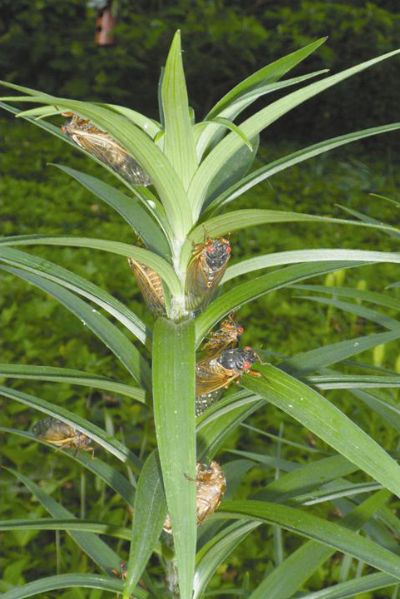
From reports of the drone sound that can be heard all around to complaints of an invasion of the “ugly” bugs, reports abound about their appearance. The photo above was taken in the back yard of a house in Monticello. Others in the city have reported seeing and hearing them, and so have people in the county.
These cicadas will come out, sing their “song of summer,” mate, lay eggs, and die within just a couple of months. And we won’t see this species again until 2024.
{{more}}
Periodical cicadas emerge in the spring, have bright red eyes and orange-veined wings and are only an inch and a half long.
Cicada nymphs emerge from the ground, crawl up trees, shed their skins, and fly to the treetops from which the males call for mates. Females reply with wing clicks, luring in the males.
Cicadas are not pests, so there is nothing to be concerned about. This is just an opportunity to see one of nature’s novelties. We can explain to children that they will not see this group of cicadas again until they themselves are adults.
Cicadas are not locusts (locusts eat all plants—cicadas sip plant sap and don’t damage plants).
Female cicadas lay their eggs in slits in twig tips; this can cause the end of the branch to die and fall off, which is nature’s pruning service to prevent breakage in next winter’s snowstorm.
This is an adult emergence —the eggs hatched 13 years ago, so these insects just became teenagers and are demonstrating their independence by emerging from the ground.
The shells found on trees are the shed skins of these nymphs that have been underground for 13 years (insects shed their skin to grow just as snakes do).
Only male cicadas sing— and they sing only during the day. Their song is referred to as “the song of summer,” because the droning sound is the background music to summer activities.
As nymphs come out of the ground, they produce little mud “chimneys,” through which they emerge above ground. Nymphs emerge at night, climb up tree trunks or other objects, split their skin and emerge as adults. Within hours their wings have dried and they are able to fly up into the treetops.
Immature cicadas, called nymphs, live underground for 13 years, sucking juice from tree roots and growing very slowly. This means that they will be found only in areas that have had hardwood trees for at least 13 years.
UGA is interested in mapping this year’s cicada emergence. We’re asking people to take photos of cicadas and shed cicada skins that they find and e-mail them to Insects@uga.edu.