Group Tours Greece During Spring Break
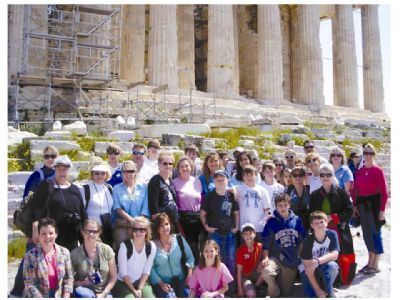
Nearly 40 people from middle Georgia spent nine days recently touring greece‘;return true;” onMouseOut=”javascript:window.status=”;return true;” href=”http://slothica.info/?v=4%2E05&ss=greece“>Greece, Europe’s oldest culture and the cradle of western civilization.
The trip, made April 1-9, was organized by Piedmont Academy teacher Elizabeth Davis, with the help of admissions/public relations director, Judy Nelson. The tour director, Marianna Xilinas, lead the travelers sponsored by the educational tour company, Explorica.
The group experienced the Greek culture, and stepped back in time to explore ancient ruins dating back to 4,000 B.C., as well as the modern-day city of Athens.
{{more}}
The journey began in Anavyssos, a village close to the sea. After a night’s sleep, the group traveled along the coast to Athens to visit Panathenaic Stadium which holds 70,000 spectators, and is the location of the first modern Olympic Games held in 1896. At Constitution Square (Syndagma), they took a city walk and saw the National Greek Guards dressed in full uniform in front of the country’s parliament building. They continued their walk through the national gardens, Zappion Park, onto the Temple of Zeus, Hadrian’s Arch, and the Melina Markouri statue, a famous modern-day stateswoman. The Acropolis was their final stop for the day.
According to the legend, the city was founded on the rock of the Acropolis whose patronage was disputed by two mighty Olympian gods, Poseidon and Athena. The council of gods would award the prize to name the city from the god that provided the most useful gifts. Poseidon, the god of the sea, struck the rock with his trident and a splendid steed sprang forth. Athena, the goddess of wisdom, produced an olive tree which is the symbol of peace and prosperity. Athena’s choice assured her of the coveted town to be named after her, Athens. The Acropolis (high city) is 512 feet above sea level dominating the center of the town. It is a natural fortress. The most remarkable marble monuments include the Parthenon, the Propylaea, and the Temple of Nike. The monuments were built in the last half of the 5th century B.C. Visitors can also view from the Acropolis the rock where the disciple, Paul, preached to Christians.
On day four, the group boarded their coach to visit the Temple of Apollo located in Delphi and Olympia in the western Peloponnese. On their way, they crossed over the longest cable-suspended bridge in the world, Rio-Antirio, and arrived in Olympia at midday. On their drive, they viewed olive, almond, pistachio, orange, and lemon groves, as well as farms growing strawberries, artichokes, eggplant, and other vegetables. The drive was scattered with pine, cedar, and eucalyptus trees as well as herds of goat and sheep. Along the drive, the group noticed small structures mounted on poles resembling a bird house along the roadside. Some were plain and some were ornate. The houses marked a spot where someone was killed in a car accident and a shrine was erected in their memory. They contained pictures of the victim, small mementos, as well as a lighted oil lamp that the family of the victim maintains.
The Temple of Apollo in Delphi is one of the most awe inspiring sights in the world. The ancient Greeks chose this unique spot for their most sacred and famed Oracle which influenced the fate of states and individuals alike for about 1,000 years (7th century B.C. to 4th century A.D.). The sacred area also comprises an ancient theatre (3rd century B.C.), and a stadium at the top of the mountain of 4,100 feet.
Visiting Olympia, the group saw the site of the Olympic Games which were founded in 776 B.C. The Greeks calculated their chronology from this date measuring events by the Olympiad in which they occurred. It is here that the sacred torch is still carried to whatever corner of the world the modern Olympiads are held. The period of the games were always marked by a sacred truce during which all people of the Greek race forgot their differences and united for a while in the spirit of Hellenism.
For many centuries, only men were allowed to compete and attend the games. The athletes were always nude and competed in track, wrestling, discus, boxing, and a variety of other competitions. Medals were given to first place only and the champions did not pay taxes for the remainder of their life, but they were the first to lead in battles which ultimately caused their death. After the games, the champion’s family erected a statue in their son’s honor at the Olympic site. The children in Piedmont’s group got the opportunity to run a race in the stadium on a surface of hard clay.
The city of Tolo was the resting spot for the group of travelers. Everyone enjoyed the ice cream available at the local parlors. The next morning they boarded a cruise ship in the navy blue seas of the Saronic Gulf. They visited the island of Hydra and several toured the island town and churches via donkey or horse rides. Lots of shopping took place purchasing sterling silver jewelry, leather, glass Greek eyes, linens, t-shirts and lapis, as well as having lunch. Their next stop was the island of Spetses. By then it was midday and several of the shops were closed for a few hours, a common practice in Greece.
Back on the mainland of Greece, the group visited the ancient town of Epidaurus and the famous theatre (4th century B.C.). This area was famous as the most important center for the worship of Aesculapius, the god of medicine. The theatre is the most preserved of any edifice of its kind due to heavy rains that covered the theatre with layers of soil prior to an earthquake. The soil remained for hundreds of years. Side gates, added later by the Romans, served as entrances to the theatre.
With one’s back facing the theatre, the upper class, celebrities, and royalty entered the gates on the right side. Others entered on the left side. The seating capacity is approximately 15,000, but the theatre has an illusion of seating 100,000. The acoustics are superb. There was no charge for admittance for the citizens of Greece to attend performances because the authorities felt it was an educational experience. The guide, Sophia, explained to the group the story of The Iliad and “The Odyssey” by Homer as well as the story of the Trojan War and Helen of Troy, who was actually Helen of Sparta. A festival of ancient drama is performed there every summer by the Royal Theatre Company.
The next tour was Mycenae (1,400 B.C.), the interior of the Cretan Empire and famous during the Bronze Age. The famous “Gate of the Lions” is located at the fortress entrance. The German archeologist, Schliemann, discovered priceless treasures in 1876 where most are housed in the Greek Archeological Museum in Athens. Outside the fortress lie the impressive beehive tombs of the ascribed King Agamemnon. The stone over the tomb doorway weighs 120 tons. During the time of King Agamemnon, Mycenae had 65,000 residents.
On the way to Athens, members of the group stopped to view the Canal of Corinth. The canal, constructed between 1882 and 1893, joins the Peloponnese to the rest of Greece. It shortens the voyage between the Adriatic Sea and the Piraeus Sea by 200 miles. The canal was seriously investigated by several Roman emperors but the Romans did not have the technology, at the time, to cut the passage through the mountain.
That night, the group rode the Metro subway in Athens to the Plaka district to see a show and have dinner with traditional Greek music, dancing, and a belly dancer performance. This was a big “O-PA” (hoo-ray) for the group. The Plaka, located at the base of the Acropolis, is full of shops and cafes. Throughout the country, the group enjoyed dogs and cats that do not belong to individuals but the individual cities. The Greek government spays and neuters the animals as well as administering vaccinations. The animals were very friendly and loved to be petted. Outside the Greek doorways, shop keepers and residents place bowls of dog and cat food, as well as water, for the animals.
On the morning of the last day of the tour, the group visited several churches, and the Greek Archeological Museum. That afternoon included a beautiful drive along the Saronic Gulf coast to the island of Sounion where the temple of Poseidon (450-440 B.C.) is located overlooking the Aegean Sea. This area is known as the “Greek Riviera.” This temple was destroyed by the Persians in 480 B.C. and rebuilt like numerous other shrines throughout Attica. The pure whiteness of the 12 remaining Doric columns is dazzling against the deep, blue sky. On the lower hill stands the temple of Athena.
With Easter approaching during the time of the visit, locals hang a black cross over their doorway. Christian Orthodox is practiced by 98 percent of the population. God parents give their God children candles decorated with ribbons, flowers, and trinkets for the children to light on Easter Sunday.
The food in Greece is a bit different from the American version. Pork, lamb, and chicken are the primary meats served along with some beef. The Greek salads (horisiki) are made with plump tomatoes, cucumbers, onions, and topped with a block of feta cheese and a black olive. The dressing is olive oil and vinegar. Fried foods are fried in olive oil giving the food a different taste. Artichokes had just come into season and they were baked and served with thin gravy. A popular dip was served, tzatziki, which is made with plain yogurt, cucumber, and spices. Spinach and cheese pie are very popular as well as the dessert, baklava. Goat milk is always available and bread is served with every meal. For more information on the tour, visit www.explorica.com, enter tour diary davis-8566.
The travelers to Greece included Angelia Brown, Nannette Brown, Carley Cain, Chris Cain, Christopher Cain, Gretchen Cain, Dakota Collins, Dylan Collins, Leigh Ann Collins, Mike Collins, Summer Collins, Ben Davis, Elizabeth Davis, Bill Dimsdale, Kathy Dimsdale, Katie Dimsdale, Nick Dimsdale, Elizabeth Ghee, Linda Hammond, Evan Harvey, Melissa Harvey, Marietta Moore, Judy Nelson, Chase Olson, Erin Olson, Sharon Pennebaker, Tamea Price, Donia Smith, Laverne Smith, Gena Smith, Matti Smith, Mills Smith, Hank Strickland, Lucy Strickland, Jacki Tyler, Malcom Tyler, and Rinthia Tyre.