Jackson Lake Dam History Is Reviewed
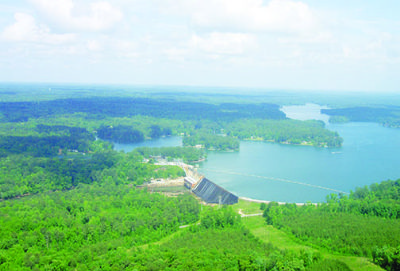
A lot of interesting facts and photos on the construction and fruition of Lloyd Shoals Dam on Jackson Lake were presented last Thursday by Benny Hawthorne and Larry Smith at Thomas Persons Hall for the Jasper County Historical Foundation.
There were about 30 people in attendance.
Mr. Smith presented what he knew about the dam that was constructed in the early 1900s. The construction began in 1908 making it one of the oldest reservoirs in Georgia. When the dam was being constructed steam and hydroelectricity was becoming popular. There was no steam in the south, according to Mr. Smith, because of the cost, the technology and the safety issues.
There was another familiar name, Thomas Eidson, who took interest in the dam. It was noted that he was very involved in the planning phases of the dam and he looked over the plans for the construction.
In the south, there are a lot of rivers and falls where the water could be harnessed and turned into power. The rural area was easily bought and construction was inexpensive for the location.
Both Messrs. Smith and Hawthorne presented information, and Mr. Hawthorne shared his extensive photo collection.
At the time the dam was completed it was the largest dam in Georgia and the tallest in the United States. The completed dam was 1200 ft. long and 100 ft. high. The falls on Jackson Lake dropped 557 ft. in a short distance making the river channel into a narrow flow. It first generated power to Macon on February 23, 1911. Later power was distributed to Griffin, Barnesville, Flovilla, Forsyth, and Jackson. It wasn’t until the latter part of the year that cable was run to the east and power brought to Monticello. It wasn’t until 1916-1917 that the final power lines were added.
William Ferguson Smith of Flovilla was a very influential man and was a believer in hydroelectric power and visited the Lloyd Shoals Dam area often. He eventually purchased 57 acres on the Butts County side of the dam to begin production. On the Jasper County side a man named McCannelis bought about 90 acres on the Jasper County side and together the dam production began.
When construction began, John Hilliard was the first construction manager (of sorts) and he ordered 44 miles of railroad to be built so that materials could be brought in to work on the dam. The railroad was used along with about 500 men. The workers stayed in tents when construction began and eventually ended up in little villages with wooden huts as housing.
The men used mules and wagons to do most of the work. The pace was slow back in the early 1900s and the workers were able to pour about 500 cubic years of cement each day. The cement was poured with large buckets that were filled and lifted using a pulley system and tool a lot of time. The dam was built using stones no larger than three cubic feet. These stones were supplied by three quarries around the dam area.
Along with time constraints, there were several problems that occurred during the construction of the dam. In the beginning, the people that lived around the Lloyd Shoals areas protested being removed from their homes. The land was lush, and was good land for farming.
Some made it as far as to go to court in Macon. There was also a frog infestation while the dam and lake were filling. There was a more severe pest, mosquitos, which caused malaria and several of the workers died from this disease. There were other deaths from accidents due to construction. There have also been several environmental dangers that caused problems, such as the snow storm of 1983 and the great flood in 1994.
To this day, Lloyd Shoals Dam is still one of Georgia’s greatest accomplishments and is in our back yard. The dam was one of the largest and best assets in the state prior to World War II. After a time, many people began to build homes around the lake and to use the lake for recreation which added to the advancement and enjoyment of the lake.