Providence Gravesites Are Located
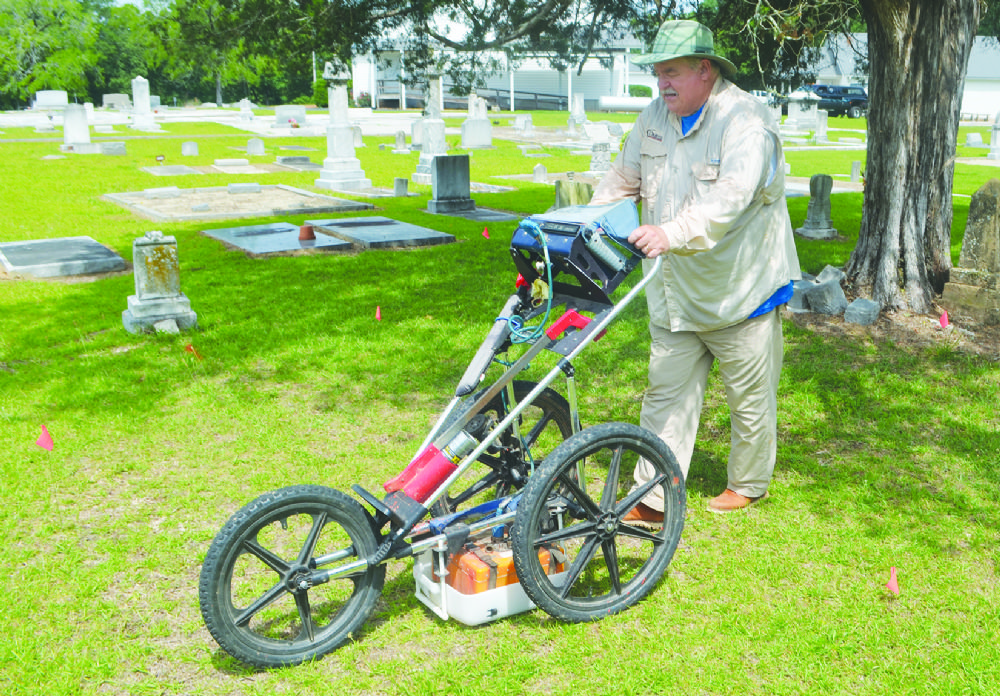
There are 146 unmarked graves in the Providence Baptist Church Cemetery, and thanks to the help of ground-penetrating radar (GPR) and global positioning systems (GPS), the church will soon know where those graves are. In addition, the church will learn where there are spaces to place more graves.
Len Strozier with Omega Mapping Services visited the cemetery Friday, and using his equipment was able to determine where the old graves are, and he placed a flag in the middle of each one. The church was aware it is an old cemetery, and that there were many unmarked graves, but did not know just how many or exactly where they were. Now they know. Or they will when they get the report from Mr. Strozier in a few weeks.
Mr. Strozier explained that his equipment is like a sonogram on wheels, and he can detect where the ground has been cut for a grave. There’s an indentation, an air pocket in the ground, he explained. The technology came about in the Vietnam era, when GPR was used to find tunnels, he said. Now it is used to find graves or, in some cases, infrastructure.
{[more}}
Mr. Strozier scans north to south to find the graves, then also goes west to east so he can determine the size of the grave and generally tell if it belongs to an adult or a child. He said people are generally buried west to east, based on Bible verse Matthew 24:27.
Mr. Strozier has been operating Omega Mapping Services for about 10 years. Before that he was a preacher for 35 years, the last 10 at First Baptist Church in Covington. He lives in Deerfield, in eastern Newton County.
He has been married to his wife, Pam, an x-ray surveyor for the state, or nearly 40 years. She travels with him when her schedule allows. For example, they took their motor home to South Dakota and stayed in it at the cemetery for a couple weeks.
Mr. Strozier learned the trade from his mentor Bob Percy of Nashua, N.H. who operates Topographix.
Mr. Strozier said wooden caskets were probably used in the oldest part of the cemetery, and some of the bodies may not have even had caskets. Iron vaults began being used as early as the mid-1800s, and at one point, vaults and caskets had windows.
He pointed to a cedar tree that is growing into a marker, and said that they can wreak havoc on graves. He said the root system of a cedar tree can go out as much as 40 feet past the canopy. Therefore, sometimes it is difficult where there are trees to determine if and where the graves are.
He has learned a lot about cemeteries doing this work. Babies are often buried at the foot of parent. He found one place at Providence where a mother was buried, presumably, and there are three babies buried beside her.
Mr. Strozier travels all over the country doing this work. He recently returned from South Dakota, and has worked in New Jersey, Florida, and Michigan.
He said that a time capsule was found at Warm Springs using this equipment. He mapped Grover Cleveland’s burial site, and found a child that had previously not been known about.
Mr. Strozier pointed out the benefit of his services. Cemetery spaces sell for large sums in some locations, so knowing where there is space can provide the owners the ability to sell more and therefore increase their revenue. He charges by the hour, day or job, depending on what it entails, and often the reward far outweighs his cost.