Cyclist Completes T. Rex Ride—RAWR!
I do a type of long-distance, self-supported cycling called randonneuring. For many years I have enjoyed group rides called brevets, organized by Randonneurs USA (RUSA). Like so many other activities, official RUSA events have been cancelled for the past few months because of COVID-19 and currently are suspended indefinitely.
Randonneuring is not racing; the only requirement is to complete a prescribed distance within a given time limit. Official brevets can be 200 km up to 1200 km. (For a quick conversion, 200 km is approximately 125 miles.) The time limit for a 200-km brevet is 13.5 hours and increases with longer distances. RUSA offers medals for finishing events within their time limits. We randonneurs are like magpies, collecting shiny trinkets!
We have been missing the challenge of brevets and the camaraderie of our rando buddies. My friend George, a RUSA member in the Hudson Valley Randonneurs club in New York, came up with a wonderful temporary substitute: the 2020 Virtual Brevet Series (VBS). He even created awards for riding a certain number of certain distances.
For example, there are awards for riding eight 50-km rides, six 100-km rides, five 150-km rides, four 200-km rides, and a Super Randonneur series (vSR) award for doing one of each of those distances. The VBS is designed to let us ride solo wherever we live. The shorter distances are doable within a single day. Although these are not official RUSA rides, they have been such a fun way to stay motivated to do longer rides.
Originally, the VBS lasted from March 28 through May 31. Then, when RUSA cancelled June events, George extended the VBS through June 30 and super-sized the awards. We still could work for the original awards, or we could double the number of rides in each category. He also added a Super vSR award, in which you do a 250-km and a 300-km ride along with the original series. Additionally, George offered the Longest Day Challenge, doing your longest ride of the year on the first day of summer, which was June 20. I was in!
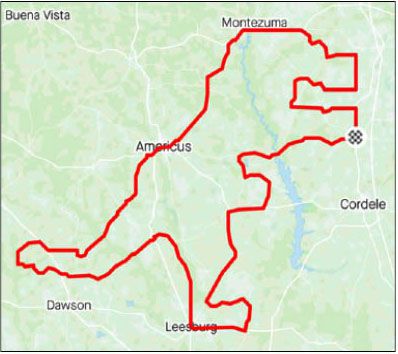
I have thoroughly enjoyed my rides for the VBS, but my 300-km ride was a highlight. It was the perfect opportunity to do something that had been on my radar screen for a while, the T. rex ride – RAWR! This is a route in Southwest Georgia that traces the outline of a T. rex. It’s about 200 miles long, a little more than 300 km. I had learned about this route through Pecan City Pedalers, a cycling club in Albany.
On June 20 I got up at o’ dark thirty and drove to Vienna, GA. I made this the starting and ending point of my ride because it was the closest point on the route to I-75. I parked in the Vienna City Hall parking lot, figuring no one would mind on a Saturday. This also provided an excellent photo opp.
Although I don’t usually wear jewelry on bicycle rides, I made an exception this time, wearing a necklace my husband Robert gave me. It has a picture of a dinosaur and the words, “RAWR! means I love you in dinosaur.”
I had recreated the route in some cycling software ahead of time to get familiar with the route. Then, I uploaded the route to my bicycle computer. It gave me turn-by-turn instructions as I rode.
I really enjoyed the quiet roads through Southwest Georgia farmland. While farming in our part of the state is primarily cattle farming and forestry, row crops are predominant in T. rex territory. That part of the state is much flatter than around here, and so my speed was higher than usual. It was a beautiful, sunny day and not too hot for June in Georgia.
Self-sufficiency is a hallmark of randonneuring, and I got to hone these skills even further on the T. rex ride. Because of the pandemic, I wanted to avoid convenience stores and potential contact with other people. I carried plenty of food with me in my large bicycle bag. I also started with two full water bottles and two large bottles of Gatorade, but I knew I would need to stop for water several times.
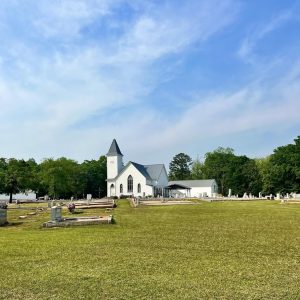
A great cycling trick is to stop at churches, which often have outdoor spigots. However, I didn’t pass many churches along my route. Fortunately, I managed just fine with water from a few unexpected places: a sink at an unoccupied, open-air deer processing facility and a spigot sticking out of the sidewalk in the tiny town of Parrott. The water at the deer processing facility was a little eeky, but beggars can’t be choosers.
There were two surprise dirt roads on the route, one at T. rex’s hand and one at the tip of his tail. I had studied the route ahead of time and was fairly confident in some detours that were paved, but I didn’t want to mess up my cycling artwork. In particular, the paved option at T. rex’s hand would have made his arm longer, which defeated the purpose. Therefore, I stuck with the original route. Some of the dirt sections were hard-packed enough to ride on with my skinny road bike tires, but I had to hike-a-bike nearly two miles total on loose, sandy soil. No problem – what’s a long ride without a little adventure?
I arrived back in Vienna comfortably before sunset. The route was within one mile of being 200 miles long. I couldn’t get that close to 200 miles without topping it off, and so I did a few laps on a quiet downtown street right before I got back to my car.
Of course, I was very tired after nearly 12 and a half hours on my bicycle, but I was grateful that I felt relatively well and had completed the entire route within daylight hours. It was such a great ride that it was almost a bonus that I got to draw a T. rex – RAWR!