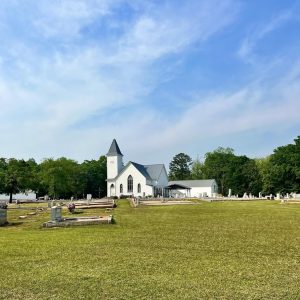
Cemetery Is Undergoing Facelift
By Margaret Watson
Historian,
Monticello First United Methodist Church
If you have driven down Short Street lately, you may have noticed some interesting activity in the Old Methodist Cemetery. Don’t be alarmed, it is all for a good cause.
After many years of neglect and the ravages of nature, the Old Cemetery is getting a much-needed face-lift by the Southern Marble and Granite Company of Macon. The cemetery served the congregation of the Methodist Church from 1805 until the last burial there in the 1970’s and is the resting-place for many of the early leaders of Monticello and Jasper County.
According to the History of Jasper County, the Monticello Methodist Church dates back to the early years of settlement of the area. The history states that in the 1790’s a group of Methodist missionaries established a small mission to the Indians near what is now Short Street. Three or four log cabins were built around the mission which was known simply as “The Village.” Circuit riders served the mission.
In 1807, the county of Randolph, now Jasper, was formed. In 1810, both the Methodist and Baptist Churches were given lots on which to build a church. The Methodists were given the lot where the former mission had been located. It is to be assumed that a cemetery of sorts already existed on this property since the founding date for the cemetery is 1805. Although there are not graves dating back to 1805, there is evidence of an unmarked grave, which could possibly have been there at that time.
The oldest known grave is that of Thomas Grant. Grant’s father, Daniel Grant, was responsible for building Grant’s Meeting House in Wilkes County, the first Methodist church building in Georgia. Thomas Grant, who came to Monticello in the early 1800’s, was one of the founders of the Methodist group in Monticello. According to his tombstone, he was a native of Virginia and a soldier of the Revolution. A man of great wealth, Grant left considerable funds to the church upon his death.
Another early grave is that of General William Lee who died in March of 1813. No information has been found so far on General Lee, but his gravestone reads: “Esteemed and honored by his family and universally beloved. His benevolence was unbounded and his virtues exemplary. He lived as he died: fearless of death and in joyful hope of immortal felicity.”
The cemetery is the resting-place of many who served their county in time of war. Besides Grant and Lee, you will find the graves of Major John C. Key (CSA), Samuel C. Charping (CSA), Captain Eli Glover (Indian Wars), Major O. G. Roberts (CSA), Major David Meriwether, Thomas Nolan (CSA) and James A. Turner(CSA). Pvt. Turner’s grave is of interest because of the unusual shape and material. It is believed to have been ordered from a popular mail-order house of the time.
In the peaceful setting of the old cemetery you can visit the graves of many of Monticello’s earliest physicians. Among them are: Dr. Edward A. Broddus, who died at the World’s Fair in London in 1851; Dr. G.M. Clements; Dr. Thomas Cook Brodus, Dr. James T. Smith; Dr. Thomas C. Davis and Dr. W. D. Maddux. Dr. Maddux was the first Mayor of Monticello and Maddux Street is named for his family. At the time of his death, at the age of 88, he was reported to be the oldest practicing doctor in Georgia.
As you stroll through the beautiful Victorian era markers of this old cemetery, you will find the final resting place of many of Monticello’s business and civic leaders. These are the people who made possible the establishment of the beautiful city we know today. It is hoped that once the restoration is completed, you will take the opportunity to visit this “place of sleep” and feel the peace that is here. Plans are under way to put together a walking map of the cemetery to guide you on your visit.
By the way, the street that runs in front of the cemetery has not always been known as Short Street.
At one time it was known as Paradise Street. Can anything be more fitting?