Man on a Mission–Wan Dad Remembered
Rayford Layson is on a mission. He wants Hwy. 212 east from the Monticello City Limits to the Putnam County line to be named for his father, Henry Grady Layson, Sr.
During the 1920s and 30s, the senior Mr. Layson owned and operated sawmills all over Georgia and Florida. His workers cut the saw timber with cross-cut saws and used teams of horses to pull the logs to the sawmill for cutting into lumber. The sawmill was always located near creek so the gas driven pump could pump the water up the hill to the sawmill because it was powered by a steam engine. The furnace for the engine used bark and sawdust for fire to heat the water for steam. Mr. Layson has put together this history through much research.
During that period, the senior Mr. Layson and the former Florence McMichael married and had three girls and five boys. The five boys all joined the military—two in the Army and three in the Air Force. Three of them have more than 20 years service to their country.
The first three children attended a one-room school a mile above the homeplace call Henderson Grove School, and he hired Ms. Hutchinson as a teacher for the school.
When they closed Henderson Grove, Grady was a big supporter of schooling and he sent one son to Hillsboro, which created a problem in the area. There was a need to get the children to school, so he purchased a one and a half ton Chevrolet with basic frame engine and windshield.
His son, H.G. Jr., drove it to a factory in the Carolina’s to have a school bus body installed. This became the first school bus in the county and it was owned and operated by him, says Rayford Layson.
The senior Mr. Layson heard talk about the government starting a farming community, so he got involved because it would require schooling for more and more children.
He and a few of the concerned men started talking to the government about plans for a school because a new community without a school just would not work. This resulted in approval for a new school that would be called Piedmont after the Piedmont region of Georgia. Mr. Layson and Mr. Amos served on the Board of Trustees until Mr. Layson’s death in August, 1947.
He, Mr. Amos, and Mr. Batchelor traveled around the South and visited colleges and hired enough teacher to staff the new school. One of the teachers told Mr. Layson that the auditorium needed a big curtain for school activities. He talked around and found a place in Macon to build the curtain and he bought it and had it installed. This school had a fully-equipped shop and hired an agriculture teacher to teach and run the shop for this new farming community.
Mr. Layson was a very quiet man who loved his family and community, said his son. That is why he spent time and finances on the farming community and school.
He did his financial business at the bank in Hillsboro. One day when he as at home for a few days, a friend from Hillsboro went over and said, Mr. Grady we heard that the bank is going to close because of the depression. He said that wouldn’t happen because the government wouldn’t let that happen. After a few days he went to Hillsboro to transact business at the bank, and it was closed. He found the bank president and confirmed the bank was closed and the government had seized all the funds and accounts. He never recovered from this and he lost his sawmills and everything except his house and 102 acres of land.
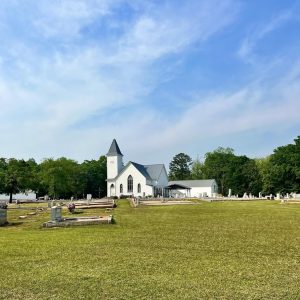
Mr.. Grady wanted his father Christopher Columbus Layson Jr. who was called “Lum” to be on record for donating the parcel for the good of the community and the advancement of education for everyone, so he donated two acres for the “colored” community to have a school and a church. The school room was later destroyed by a tornado and the school teacher was killed. The church and school lumber and materials were furnished by Mr. Layson. The church is now called Griggs Chapel.
Rayford Layson compiled this information that was obtained form family members and others in the community.