Middle Georgia Author Ride
Besides cycling, one of my favorite things to do is read. Recently I combined these two passions in a Middle Georgia Author Ride. Middle Georgia seems to be fertile ground for excellent writers to grow. My ride highlighted three of them: Joel Chandler Harris, Alice Walker, and Flannery O’Connor.
When I first mapped my route, it had around 90 miles. So, I went ahead and added a few extra miles to make it a full century (100 miles). I anticipated riding solo, but I was thrilled when my husband Robert agreed to join me. He’s such a good sport.
Joel Chandler Harris
Our first focus was on the tales of Uncle Remus, recorded by Joel Chandler Harris. Harris grew up on a plantation in Putnam County, where he heard slaves tell about the adventures of Brer Rabbit and the other critters.
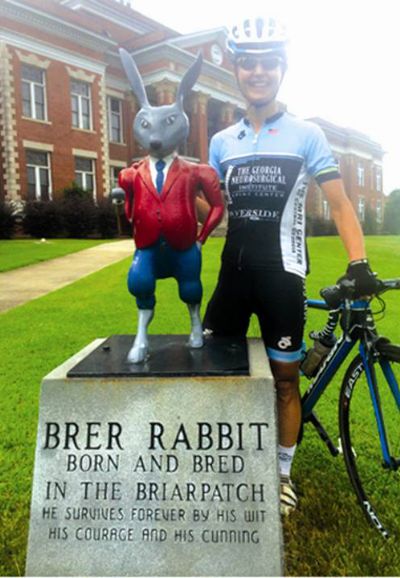
As Robert and I rode into Eatonton, I made sure to stop at the courthouse to visit Brer Rabbit.
From there, we headed to the Uncle Remus Museum. The volunteer working at the museum that day was a delightful woman named Georgia. She was simply full of information about Joel Chandler Harris, the Uncle Remus stories, and life in general both before and after the Civil War. She shared with Robert and me a number of stories from her grandmother, who learned much from her own grandmother, who was a slave.
Georgia explained that the Uncle Remus characters are not “animals.” They are “critters.” Maybe it should be obvious, but I learned that the critters are symbols; Brer Rabbit represents the slaves, and Brer Fox represents the plantation owner. In the seemingly innocuous tales of Brer Rabbit outwitting Brer Fox, the slaves who handed down the stories were actually sustaining hope that they would overcome.
Georgia would have kept talking to us all day long, and I would have been glad to keep listening if I didn’t have other authors to explore on our journey. Georgia gave us a terrific segue to Alice Walker, our next author.
When Robert and I mentioned that we were on our way to her birthplace, she said that she knew Alice Walker, who was a few years behind Georgia in school. Georgia said that back then she and her friends had only two things on their mind: boys and orange lipstick. She said that they would pool their funds and share an orange lipstick, laughing that they all looked like Bozo the clown. The young Alice, however, was very studious and smart, writing poetry and pretty much shunning the more adolescent pursuits of her peers.
Alice Walker
I got some ambiguous information on-line as I was planning this Middle Georgia Author Ride. I found the address for Alice Walker’s birthplace. It appeared to be part of a property that includes a restored farm, general store, and events venue, but they must be two different locations. The address I found on the Internet did take us to her birthplace, but there’s nothing there except a faded, barely readable sign.
Earlier this summer I read Alice Walker’s most famous work, The Color Purple. I’ve been aware of it, however, since high school. In 10th grade my English class was to read Lord of the Flies. That was the only time my mother objected to any book I was assigned in school. She thought Lord of the Flies was too violent. Mrs. Phillips, my English teacher, obligingly agreed to let me read an alternate book. My mother suggested The Color Purple.
Mrs. Phillips was rather flummoxed, wondering why my mother preferred that I be exposed to the violence in The Color Purple. I actually wound up reading The Martian Chronicles by Ray Bradbury. I’m so glad that Mrs. Phillips introduced me to Ray Bradbury because he’s been one of my favorite authors ever since. I’m also glad that I finally read The Color Purple. By the way, my current to-read list includes Lord of the Flies – a little delayed teenage rebellion (heh heh).
The thing that resonated the most with me in The Color Purple was Alice Walker’s description of how she experiences God. God is real. But God is not the old, white man in a robe that too often comes across in church. I experience God more as Alice Walker and her character Celie do: in flowers, wind, water, or a big rock. My favorite chapter is the one that gives the book its title. Celie begins seeing God in a whole new way thanks to her friend Shug. Shug explains that we please God by noticing and loving the things around us – like the color purple in a field somewhere. At the same time, God is always trying to please us back, “making little surprises and springing them on us when us least expect.”
Flannery O’Connor
Robert and I rode on from Putnam County and headed toward Milledgeville. After stopping for lunch in downtown Milledgeville, we pedaled to Andalusia. Andalusia was Flannery O’Connor’s home during the last years of her life.
The house is a short distance from the highway, hidden by trees. Both the inside and outside look just as they did during the 1940’s and 1950’s. It’s easy to imagine the importance that sense of place played in Flannery O’Connor’s writings.
I learned that not only was Flannery O’Connor a writer but also an artist. In her tribute, students at nearby Georgia College, which is also Flannery O’Connor’s alma mater, have created a number of pieces of art, displayed in a back corner of the house. I especially liked one piece of wall art that was evocative of peacocks. Flannery O’Connor kept a number of peafowl, which is the generic term including both male peacocks and female peahens. Several peafowl are kept today at Andalusia.
I’m pretty sure that in high school I read “A Good Man Is Hard to Find,” which is probably Flannery O’Connor’s most well-known short story. I re-read this story shortly before my Middle Georgia Author Ride. What a perfect example of Southern Gothic literature: characters that are slightly (or greatly) “off,” violence, and a definite sense of locale. As I’ve been reading Flannery O’Connor’s short stories this summer, what has really grabbed me is the grace that shines through, even in disturbing or even macabre circumstances.
“She would of been a good woman,” The Misfit said, “if it had been somebody there to shoot her every minute of her life.”
It was time to head home. We had a straight shot back from Milledgeville to Monticello on Hwy 212. The long day of riding made me tired, but it was well worth it.
The South has a difficult history, full of slavery, racism, and poverty. Joel Chandler Harris, Alice Walker, and Flannery O’Connor have shown that that’s not the whole story, however. Whether it’s telling of the underdog prevailing, asserting the possibility of a conscious connection to All That Is, or showing improbable redemption, these authors offer hope to all of us.