Commissioners Demand District Boundaries that Won’t Work with Schools
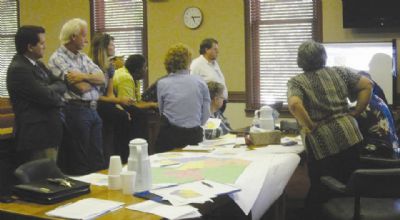
“Please, one at a time,” consultant Linda Meggars instructed the gathering of county commissioners and school board members and staff Monday while they were trying to develop a new district map that follows the law, and at least somewhat pacifies the person currently representing each district.
The commissioners and school board had seen a map last week, developed by the Regional Development Commission, but county commissioners did not like the map, and it turns out some of the numbers were skewed. So, they voted to bring in an outside consultant. Ms. Meggars was the director of the state re-apportionment office for 37 years, and now works as a consultant.
Monday afternoon’s meeting was attended by all the county commissioners and three school board members, along with Supt. Dr. Mike Newton, Assistant Supt. Eric Arena, County Manager Greg Wood, Assistant County Manager Lorri Smith, and Elections Superintendent Linda Mock-Keller. The goal was to develop a district map that would keep county commission and school board districts the same so as not to confuse voters and to lessen election expense. However, as the meeting got going, it appeared that would not happen.
The meeting got under way with Ms. Meggars explaining the rules. She said the first thing to consider is “one person, one vote.” That ruling requires the districts to be as even as possible in population so that each person has equal representation. The law allows a five percent deviation range from the ideal. More than that will be questioned.
In addition, she explained, districts must comply with the voting rights act which assures racial parity. She said it is important that there is not regression.
{{more}}
Currently Jasper County has one predominant minority district—District 1, which is represented by Carl Pennamon on the commission and Bobby Norris on the school board. In the past District 2 was also a majority minority district, but the percentage of minorities in the county has dropped, so there will not be two majority minority districts. County Commission Chairman Charles Hill was concerned about the number of minorities in his district as was School Board Chair Phyllis Norwood whose district is the same as Mr. Hill’s.
Ms. Meggars also explained that although the population summary report lists people of Hispanic origin separately, that is not a race. It is an ethnicity, she said. The RDC counted those people twice, which is why its numbers were wrong.
In addition, in the past, persons who did not describe themselves as black were not necessarily listed as black. In the last census, persons could describe themselves as all or part black, and those numbers were included in the minority count.
Ms. Meggars also reminded those gathered that state and national re-districting will take place in the coming months.
Once Ms. Meggars had explained the law, she presented a plan that she had drawn up based on the plan from the RDC with some changes the commissioners had wanted and with the guidelines Mr. Wood gave her. Then they all started talking. Commissioner Jack Bernard said he thought it was important to keep communities together. He said he didn’t work with anybody at the RDC, and he didn’t accept it.
He was adamant that he wants all of Turtle Cove to be in one district and he wants to represent that district. Commissioner Alan Cox said that his district along the Bear Creek area of the lake and outward already fell within the parameters required, so why change it. Commissioner Mary Patrick expressed concern that the county and school districts needed to remain the same.
Under the proposal from RDC, and the amended proposal from Ms. Meggars, Commissioner Patrick’s new district would be District 3, and she was coordinating with Dr. Shannon Barton who represents District 3 on the School Board.
Early in the discussion, Ms. Meggars suggested that rather than trying to address all the districts at once, that a methodical approach should be taken, starting with District 1. However, within moments several commissioners were talking at once again.
As the commissioners tried to tweak the map and make the changes they desired, they learned how difficult a job it can be. It has to be done by census blocks; that’s the only way to know the population of an area. And, in much of the county, a commissioner can take in much more land, but still encompass just a few voters because of the sparse population throughout the county.
The two population centers are the city of Monticello and the lake area. Everywhere else there are basically few people per square mile.
After considerable discussion and no progress towards the goal, Commissioner Pennamon said he had a map he had created that came closer to the concept of what the commissioners wanted. The commission then started picking that one apart.
Only Commissioner Patrick voiced her concern that the school and county districts be identical. However, Commissioners Hill and Pennamon’s districts in each example would achieve the same purpose, based on where the elected officials live.
However, both commissioners Bernard and Cox live on the lake, and want that to be their main representative area, while none of the school board members live on the lake. Commissioner Bernard made it clear from the beginning he did not care if the districts overlapped, and Commissioner Cox seemed to agree.
When they worked on the map that Commissioner Pennamon produced, they came up with a map that the four remaining commissioners appeared to agree on; Commissioner Patrick had left the meeting by then. The school board members were also leaving, recognizing they may have to go their own way.
Then Commissioner Hill returned, and expressed his displeasure with the map. However, the commission had adjourned with the appearance of satisfaction. That map is pictured below. If the county winds up adopting it, many voters will find themselves in one school board district and another county commission district.
The Board of Education and Commissioner Hill were planning to go to the state reapportionment office yesterday, July 27. The school board may go with the one designed by Ms. Meggars, first discussed by the group, with a few tweaks.
The map question has to be settled in time for the legislature to adopt it next year.