The Process of Writing the Book, Gone With the Wind
(Editor’s Note: This is part two of a three part series about the book, Gone With the Wind which celebrates the 75th anniversary of the publication on June 30.)
Chapter One
As Margaret Mitchell had been a former newspaper writer, she began her book as she would have any other news story. You write the current facts then proceed with the history of the event. So, it was with the beginnings of the book, Gone With the Wind.
In the original Chapter One, Rhett Butler has given up on the marriage to Scarlett O’Hara, put his hat on and told her that she didn’t understand him and says he is leaving her. She asks him what will I do, where will I go. He looks at her while opening the door to leave and says those immortal words, “Frankly, my dear, I don’t give a damn.”
It is reported by some that there was a long fight to get that complete phrase included in the movie. In the end, all the controversy may have been publicity by the studio, but they did pay a $5,000 fine to say the word, damn.
Mitchell spent many hours at the local library doing research on Civil War battles, soldiers, medical care, surgery and especially about Atlanta and Georgia during the War and Reconstruction. The archives department at the Atlanta Journal was a vast treasure trove of information Mitchell used. The Journal was started in 1868. There were quite a few Civil War veterans still alive, including both of Mitchell’s grandfathers. Both sides of her family had lived in the Atlanta area for generations. As a child she heard stories first hand from those in her family.
Characters
Many of the characters resembled relatives of Mitchells’. One of Margaret’s aunts was named Melanie. Melanie fell in love with a cousin. In the book Melanie also falls in love with her cousin. In real life, her aunt was not allowed to marry her cousin. She was so heartbroken that she became a nun and lived in Savannah.
The cousin that she was in love with was actually Doc Holliday, gambler, gunfighter and dentist. Holliday studied dentistry and practiced in Atlanta while living with his uncle and their family. After the spoiled romance, he left Atlanta and went West associating with legendary Wyatt Earp and the town of Tombstone. Mitchell had asked her Aunt Melanie if she could use her name for a character in the book and she agreed. After the publication, her aunt wrote her and chastised her for using her name in that vulgar book.
Rhett Butler
Mitchell’s first husband, Berrien Upshaw, was most likely used as the basis for the character, Rhett Butler. Upshaw was a bootlegger by trade; it was the time of prohibition. This marriage was doomed from the very beginning. Margaret was raised to be independent and strong-willed. Upshaw and Mitchell fought and he beat her. After four months, he left her.
Her next husband, Upshaw’s best man and best friend, John Marsh, was waiting in the wings and by 1925 they were married. John Marsh had a stable job working for Georgia Power and also editing its inhouse magazine. He encouraged Margaret to write again.
He was completely opposite to the violent Upshaw. John Marsh more resembled the character in the book, Ashley Wilkes.
Mitchell’s mother in real life died before Margaret could get home to Atlanta from college in Massachusetts. In the book, Scarlett’s mother dies before she can get back to her home place, Tara. In real life, Margaret’s mother was a suffragette, marching and demonstrating to get women the right to vote, she was a founding member of the League of Women Voters in Georgia, very faithful to her religion, Catholicism. In the book, Scarlett’s mother is the leader of the household, taking care of her family and the community, also very faithful to her religion, Catholicism.
Margaret was born into the new century, had lived through the roaring twenties, prohibition, experienced World War I, losing a fiance in that war, suffered through a failed marriage, death of a parent, and was living through the Depression.
The events of her life, the people that she knew, relatives who had lived through the Civil War, seen fortunes made and lost, walked the streets of Atlanta, the renaissance city of the South, rising from the ashes, all these things helped shaped the characters and stories that Mitchell wrote in the Book.
Beginning
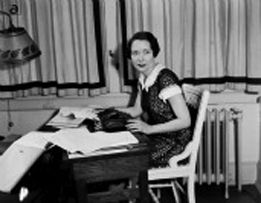
She began to write the Book in 1926. By 1929, it was basically complete, but she continued to a refine the product. After she married John Marsh, she had become a homemaker giving up her job at the Atlanta Journal. Until 1935 she would rewrite, add comments, sometimes just a scrap of paper put into an envelope. The manuscript had grown to nearly 70 chapters. In the small, two-room apartment, she stored the chapters in used manila envelopes, Piggly Wiggly shopping bags under the bed, in the window box seat, and under the Singer sewing machine cabinet that was her typing table.
When friends and family came to visit, she would hide any of her work with tea towels. There were very few people who knew she was writing a book. Mitchell never thought that her writing was up to par and never sought a publisher.
Chance Meeting
In 1935, Harold Latham, an editor with Macmillian Publishing in New York City, was in Atlanta looking for fresh manuscripts about the South. By chance, Margaret was invited to lunch with her former Atlanta Journal writers and Latham was also there. Her friend knew that she had been writing for years a story about the Old South. She mentioned to Latham that Mitchell had such a novel and he asked to read it. Mitchell refused until her friend chided her by saying that Mitchell probably didn’t really have a book, because she could never settle down that long.
Incensed
Incensed, Mitchell went home after the lunch, got the jumble of envelopes and Piggly Wiggly bags and met Latham at the train station as he was leaving for New Orleans. He had to quickly buy a large suitcase to carry the manuscript with him, he nicknamed it the Mess in the South.
On the train, he began to read the story, realized he had hit paydirt and shipped the manuscript to New York City for others to read. Soon Margaret was offered a contract and an advance of $500. Her contract was 10 percent royalities for the first 10 thousand copies and 15 percent thereafter.
The editors at Macmillian saw great potential, but asked Mitchell to make the first chapter the last and to write a new first chapter. They also did not like the name of the book and the main character Mitchell had chosen, Pansy. She gave them several other options, Tomorrow is Another Day, Tomorrow, Tote the Weary Load, Milestones, Ba!Ba! Black Sheep, and on and on.
Then Mitchell remembered a line from a favorite poem by Ernest Dowson, “I have forgot much, Cynara! gone with the wind.” Pansy’s name was changed to Scarlett. With that change alone, hundreds of pages had to be corrected. Mitchell, her husband, a stenographer and a typist spent weeks revising the pages. The typist was paid 50 cents a page to retype any page with corrections and there were hundreds.
Hours were spent researching to correct historical parts of the story including Civil War history. Margaret loved words and descriptive phrases and incorporated them into her epic novel. She used words, furbelows, venality, tableau vivants, usurper and passementierie which probably sent her readers scrambling for their Webster dictionaries.
By January 22, 1936, the final revision was done. On May 19, 1936, Gone with the Wind was published and on June 30, 1936, the Book went on sale in bookstores around the United States. Twenty thousand copies had been ordered in advance. When Mitchell and her husband had been musing about the number of copies that would be sold, he told her that between them they had five thousand cousins in Georgia who would buy it. Some 50,000 copies sold the first day.
Movie Rights
On May 20, 1936, Kay Brown, a story writer hired by film producer, David O. Selznick, to look for new material, enthusiastically recommends Gone With the Wind for a future project.
May 21, 1936, Mitchell gives Macmillian Publishing the right to sell Gone With the Wind to the production studio.
July 6, 1936, David O. Selznick wires Kay Brown authorizing her to pay $50,000 for the movie rights for the book;, the publisher accepts. That amount was the highest ever paid up to that time for the movie rights for a book.
The whirlwind and hysteria surrounding Gone With the Wind begins; it will culminate in Atlanta, on December 15, 1939 with the premiere of the movie.