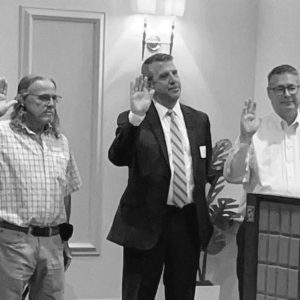
Commission Covers Many Topics in Work Session
Three of the five Jasper County Commissioners met for a work session last Thursday, and although they discussed numerous items, none were added to the agenda for Monday’s meeting as it had already been published.
Action on those items would have to take place at a future meeting. Some of the items, however, were informational only, and require no action.
Commission Chairman Jack Bernard, District 3, and Commissioners Charles Hill, District 2, and Greg Johnson, District 4, were in attendance.
Commission vice-chairman Bob Yarbrough, District 5, and Commissioner Carl Pennamon, District 1, were not present.
Ronnie Payne talked to the commissioners about combining fire and Emergency Medical Services and how it could be phased in and reviewed quarterly or even monthly to see if it’s working.
He said eight of the 12 EMS personnel are already cross-trained for fire, so the new protocol could take effect immediately. The proposal calls for the changes to begin March 1, but could be implemented at any time. Medics at Station 1, Jackson Lake, would begin response on apparatus as outlined in the Standard Operating Procedure (SOP) draft.
Within 90 days, the committee will meet with all personnel at the station to determine if plan is satisfactory.
The plan calls for the medics to move out of Jasper Memorial to Station 3, Monticello, 30 days after Station 1 goes online. Then, within 90 days, the committee is to meet with all Station 3 personnel and see how things are working. It could revert to the current way at any time if needed.
Mr. Payne said the committee couldn’t give a timeline as such for future growth and costs, but instead based future expansion on population growth.
Commissioners heard from Public Works Director Larry Thurman that the van used to transport the prison detail burned up, and until it is replaced, the county is paying for the detail, but getting no service. The contract requires Jasper County to provide transportation.
Commissioners also discussed proposed purchases of pick-up trucks for the landfill, planning and zoning and parks and recreation. Commissioners urged the County Manager to be certain of the need before moving forward with any purchase. If the purchase can wait until next year, that would free up some funds in this year’s budget they said. The landfill truck would be a four-wheel drive pick-up, and the others would be Ford Rangers, most likely.
Ken Tillman of the Jasper County Landfill gave commissioners an update on the progress of permitting a new C&D (construction and demolition) landfill, while telling them the sanitary landfill is closed but will require monitoring for 30 years.
He said he did not know what the hold-up was on the permit, and suggested, he along with the county manager and the engineer meet with state officials on the topic. When asked the cost, Mr. Tillman said the C&D landfill will cost $50,000-$60,000, but he feels the county can generate the revenue to pay for it. He has said in the past that it would be a needed service to residents, and would likely be cost effective.
Georgia-Pacific currently hauls waste to a site outside of Jasper County. Mr. Tillman feels certain the company would use the local site if available, because it would cost them less. The company will not commit to the use.
Commissioners were given a new fee schedule, provided by Ken Baldwin. The schedule addresses rezoning fees, preliminary and final plat fees, special exception and variance costs. The table provided to the commissioners compares Jasper County’s fees with those of Butts, Cherokee, Henry and Oconee Counties. Commissioners also received a copy of proposed fees for ordinance violations.
Commissioners discussed the Special Purpose Local Option Sales Tax (SPLOST) roads program. Commissioner Hill said one of the roads listed for his district was incorrect, and said he had told interim county manager Leonard Myers of the problem when it first arose. Joan Bell who served on the SPLOST committee said the list of roads was included in the intergovernmental agreement, and therefore was binding.
While discussing roads, Mr. Bernard said that if we’re going to get into a $9 million roads program, the county needs to hire a part or full time engineer. Mr. Williams said if the county contracts with a firm to oversee the SPLOST projects, it is costly, but SPLOST funds can be used to pay the firm and the headache is removed from the county. However, if the county hires someone to do the work, that person could not be paid by SPLOST funds.
Mr. Bernard said they should look at funding an engineer by reducing county overhead. Mr. Williams said the consulting fee would be about $950,000. Commissioner Johnson said, “that’s 20 miles.” Mr. Williams allowed it would reduce the value of the SPLOST.
The nature of the work session is informative, and no decisions were made. Commissioners call the meetings work sessions as they do not intend to take any official action. In reality, the meeting is a public meeting when notice is given and a quorum is present so legally action could be taken.
{{more}}
The work session began with county attorney updates after the public comments, partly because John Nix’s presence was required at another meeting in the Courthouse later in the day. Mr. Nix informed the commissioners that the law is not clear on who should pay for road improvements associated with building the new high school.
He said the work must be done, so he went ahead and had the county manager put it out to bid. The County Manager was to meet with the Department of Transportation Friday, and since the DOT has agreed to help Jasper with its roads program, they feel like the state will help fund the improvement.
Commissioner Bernard said that he, School Superintendent Jay Brinson, and Commissioner Pennamon had a conversation with Harold Linnenkohl, DOT chairman, who said the county would have state funds.
Mr. Nix said he is not making much headway with the questions involving Hwy. 380, but is working on it.
He discussed the “enabling legislation” which created Jasper County, and the revisions to it. He explained no one was trying to revamp the county, only to clarify legislation affecting the county. The last revision was done in 1986.
Mr. Nix explained no revision to the enabling legislation can be changed on the local level. He outlined some of the problems. In the mid-1990s, the county created the County Manager position, but no powers were given. The county manager can be empowered at the local level or through legislation. The current legislation does not identify what the chairman does. The legislation also designates meeting day. What is in the legislation is not what is currently practiced.
Mr. Nix said the purpose was not to rewrite the form of government but to enhance what has been done. The whole idea was to consolidate what is already in place.
He also mentioned that he thought it odd that all five commissioners get elected at the same time.
Mr. Nix did not mention salary and reimbursement expense, but those are the issues that led to the county wanting to change the enabling legislation.
After Mr. Nix completed his presentation, Commissioner Bernard went on a tirade criticizing the local paper as has become a habit for him. He said he is not being reimbursed for a phone line, and no one is being reimbursed for in-county travel. He also said the retreat (in December) was open to the public.
Commissioner Bernard received reimbursement for a phone line at his home for most of last year, before Mr. Williams told him it was inappropriate. He has since repaid those funds.
When this commission first took office in January 2005, Commissioners Bernard and Yarbrough submitted expense reimbursement forms for travel in the county and local meals. Mr. Bernard, in fact, never did receive that reimbursement. The newspaper reported the request for reimbursement and it was withdrawn.
Mr. Williams told commissioners the USDA grant application could not be approved until a balance sheet is provided. He said they have had some problems but expect to provide it within the next two weeks.
He gave commissioners an update on how parking could be added near the Courthouse, and said he is asking Mr. Thurman to give him some estimates.
Mr. Williams and Mr. Nix talked to the commissioners about the Chief Magistrate’s status. Is he full time or part time is the question. The county asked him to provide time sheets, and he has respectfully declined, said Mr. Williams. Mr. Williams plans to investigate, and if he can’t find the authority that makes the chief magistrate full time, he will recommend to the board to fund it as a part time position next year, and inform the Chief Magistrate of the action.
Mr. Williams also said he is exploring the implementation of a county website and newsletter.
Near the end of the meeting, Mr. Bernard asked who is controlling expenses in the courts. He said the county keeps receiving “outrageous bills for indigent legal defense.” The county thought that funding the new state mandated public defender would cut down on expenses to individual attorneys.
Mr. Williams said the question should be referred to Mr. Nix, who had left that meeting by then to attend the assessors meeting.
Commissioners discussed future dates for meetings, trying to figure a timeline to have a work session prior to the regular meeting, allowing the County Manager time to publish a regular meeting agenda after the work session, but not allotting too much time between the work session and regular meeting where action will be taken.
The commissioners tried to align the meeting dates with check signing requirements, and Mr. Williams suggested again that perhaps staff should be able to sign checks rather than requiring commissioners to come to the Courthouse to sign checks.
Towards the end of the three-hour meeting, Mr. Bernard said that a lot of this stuff could be handled with an e-mail or a memo, indicating the commissioners’ time was too important to listen to all that they did.
Joan Bell addressed the commissioners during general comments saying that she thought the idea of the work session is great, making sure the public is aware of what is being discussed.