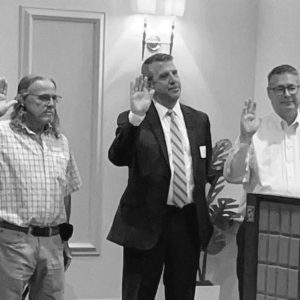
Commissioners Forego Raises
The Jasper County Commissioners met for more than three hours Monday night in a “work session,” in an attempt to be prepared for next Monday’s regular meeting where a vote may be required and to become informed on matters that do not require a vote.
During the discussion of what should be on the agenda for the monthly work sessions, County Manager Greg Williams pointed out that a number of items were there primarily for information purposes. If he does not give the commissioners this information at a work session, he asked, when and how should he disseminate the information.
Commissioner Greg Johnson (R-District 4) said he realized he should be more involved, in fact all commissioners should be more involved. For his part, he said beginning March 1, he plans to spend from 8 to 10 a.m. in the Courthouse every day to help the county manager and generally be hands-on. If his work schedule does not permit him to maintain those hours, he will make adjustments.
The continuing debate on who should sign checks was resolved. Commissioner Johnson said since he would be available to sign checks each week, surely one other commissioner could come to the Courthouse for the second signature. The new policy will allow any two commissioners to sign checks.
The county manager was suggesting that he and the Chief Financial Officer sign checks, because often it is hard to find two commissioners to sign the checks. Mr. Johnson felt like his presence would eliminate that problem.
Commission Chairman Jack Bernard (R-District 3) has continually shown support for allowing “staff” to sign checks, saying the commission would review the expenditures and all expenditures have basically been approved through the budgeting process. Members of the public and Commissioner Carl Pennamon (D-District 1) have been reticent to delegate that duty.
When this set of commissioners first took office, they voted that the Chairman and Vice-Chairman would sign checks, and if they were not available other commissioners could sign the checks. The new policy will be brought before the commission for a vote next week.
Commissioner Johnson said he has a number of goals for the county, and hoped that his presence in the office would be beneficial in achieving these goals. He listed his goals as:
•Developing a road plan for the county.
•Improving the personnel policy.
•Assuring the new C&D landfill is open by summer.
•Creating a centralized mail room.
•Creating a centralized purchasing department.
•Begin working on the budget so it can be ready in a timely fashion.
{{more}}
The commissioners agreed that rather than rush through a change to Jasper County’s enabling legislation during this General Assembly that instead they would continue to review what is currently in place, make necessary changes, and plan to present something to the General Assembly next year.
Along that line, the commissioners agreed that any increase in pay should take effect when the new County Commission takes office, in 2009. If these commissioners are re-elected or new ones replace them, that is who would be the beneficiary of the increased pay.
Commissioners also agreed not to introduce anything on the order of expense reimbursement at this time. Commissioner Charles Hill (D-District 2) said he felt the mandated 10 cents per mile reimbursement for travel outside the county should be changed. Mr. Bernard said that he didn’t think that minor change should be made to the enabling legislation; instead wait until the complete change is ready—likely next January.
Commissioners reviewed a proposed ordinance regarding the county manager, and after much discussion agreed to delay any approval until changes could be made.
One item that held up the commissioners was the item that said the county manager would prepare the agenda with the approval of the chairman. Several commissioners, as well as members of the audience, have expressed the opinion that the chairman has too much authority already, and should not have to approve the agenda.
Mr. Bernard said he thought that was what they agreed on in their December work session. Besides, he said, it was purely boiler-plate wording that came straight from ACCG. After much discussion, it was agreed to remove the phrase, “with the approval of the chairman.”
One welcome item the commissioners received was a financial statement, compliments of Chief Financial Officer Susan Raynor. Ms. Raynor began working for the county earlier this year, and this was one item the commissioners expected of her.
Ms. Raynor presented the report showing where the county stands in relation to revenues and expenses. She asked the commissioners for feedback on the format presented. She said her accounting program prepares a report, but she felt like it was confusing, so she created the report she presented in an effort to be understandable.
Commissioners agreed that a line item for contingency needs to be added, but otherwise had little input other than to praise Ms. Raynor for presenting the document.
Charles Forsythe, a member of the audience, spoke during the general comments portion of the meeting saying he felt the report was inaccurate. He said if it was right, the county would only need a budget of $6.6 million rather than the $8.1 million it has budgeted.
He also took issue with a proposal from County Attorney John Nix about the Hwy. 380 proposal.
In an ongoing dispute, the county is seeking repayment from property owners the money that was improperly returned to them.
During the 1990s, the county acquired land which would be the right-of-way for the expansion of the perimeter road around the city of Monticello.
The status of the project changed, and state Department of Transportation officials advised the county to return the land, saying the project would be stymied if the county did not immediately return the right-of-way.
The county gave the land back to the parties from whom they had purchased it. Several years later, the question was raised as to why the property owners did not return the money paid for the land. It has been an ongoing dispute for several years. The transactions involve a large corporation which has since sold the land, apparently, and a few local property owners. The cost of the right-of-way when it was originally purchased was under $20,000 total.
When contacted by Mr. Nix, one property owner suggested rather than repaying the money, why not just count the money already received from the county towards the new purchase of the right-of-way which will undoubtedly take place if the road is to be built. Mr. Nix advised if the commission agrees to do that with one landowner, it would likely be the route to take for each landowner.
Commissioners discussed the purchase of a truck for the planning office. The new truck would actually be for animal control, and a memo from building inspector Ken Baldwin was presented. In the memo, Mr. Baldwin justified the need for the new truck. Commissioners had asked the county manager for clarification when the purchase of this vehicle came up. The memo was an attempt to clarify the need.
However, discussion among the commissioners revealed they do not think the building inspector and code enforcement officer each need a four-wheel drive truck. Their forays into areas where that type vehicle is needed are infrequent, suggested Commissioner Bob Yarbrough (R-District 5), and perhaps the person who needs it at any given time could swap with the other person.
Mr. Williams said he was unclear on the issue. The commissioners had approved the purchase in the budget process, but now did not want to go through with the purchase. The commissioners discussed the anticipated fund shortage for this year, and said they just weren’t sure the purchase was justified.
Mr. Williams suggested to the commissioners that the personnel policy be changed in regards to sick leave. He said that the county’s personnel policy indicates an employee can accumulate 14 days of sick leave per year, but the same employee must be there 10 years to receive that much vacation. He said that he’d like to make some changes, saying that he can regulate vacation leave, but not sick leave.
Therefore, it would be more beneficial for the employees to have vacation at an approved time, rather than almost being encouraged to take a sick day because they have so many.
He also said when the job review and classification study is complete, regular evaluations will be required. He said virtually all of an evaluation is subjective, but an attendance report can be objective. Commissioners told Mr. Williams to move forward with a draft for their review.
Mr. Williams reported that he reviewed the Service Delivery Strategy (SDS) and only found one basic error. He said the strategy said Jasper County Water & Sewer did not have lines yet, and it does have lines now. Other than that, he said, the objections raised by several last month were unfounded. He said that many items say the funding is split, but it does not give the percentages in the document, so they are not wrong.
Cathy Benson and Juanita Gazaway both maintain the SDS is wrong in regards to water service areas. A judge recently ruled against Alcovy Shores Water & Sewer Authority in a lawsuit it brought in an effort to thwart JCWSA expansion.
Planning Director Chris Anderson spoke briefly to commissioners about impact fees. He said that he has a proposal from Bill Ross, apparently the only person in the state who helps implement impact fees. He said that Mr. Ross would charge $39,700 for a study and recommendation on impact fees. Once instituted, there would be a fee of $8,000 the second year for maintenance.
Commissioners questioned how long it would take the county to recoup those costs if it implements impact fees. Mr. Anderson is to investigate and report back to the commission.
Mr. Williams told commissioners he had talked with several firms about web sites, and he is pleased with the proposal from a firm in Conyers.
He said when instituted, each county employee with a need for it would have an e-mail address at Jasper County. He said it will not take long to get the website up and running, and once it is, minutes, financial statements, contact information and other items could be posted there, increasing accessibility by the public.
Commissioners adjourned the work session without having the executive session that was indicated on the agenda.
(A work session, by the county’s definition, allows no official action to be taken. However, to go into closed session a vote is required, and therefore official action is taken. Apparently, commissioners opted to eliminate that item because of the ambiguity.)