Searching for Gus
A lovers’ triangle. Murder. Flight from the law. Is this a plotline from Days of Our Lives? No, it all happened in Monticello in 1833.
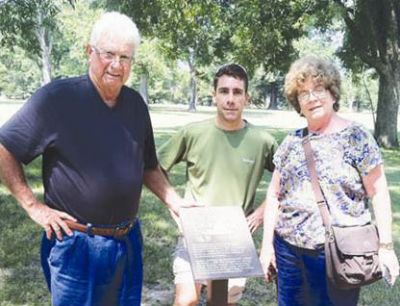
Recently, Robert (my husband) and I took Linda and Neil Jordan (his parents) on a weekend trip to Arkansas to see if we could learn more about Augustus “Gus” L. Glover, a distant relative.
On October 8, 1833, Gus shot and killed James J. Ross with a pistol. Family lore says that these two men had a dispute over a woman. Eli Glover, Gus’s father, hid his son from the sheriff. Knowing that this was not a long-term solution, however, Eli secretly sent Gus to Alabama to start a new life. Soon thereafter, Eli was tried as an accessory to the murder his son had committed, but the jury found Eli not guilty.
A Proclamation Book (legal record) from Jasper County gives the following description of Gus: “20 years old, black eyes, tall and slender, 6 feet high or more, and has a fierce and daring look.” Maybe that fierce and daring look was an indicator that Gus wouldn’t stay too long in Alabama. He killed another man and took flight again.
This time Gus headed to Arkansas Post, Arkansas. Historical accounts suggest that a rough crowd frequented the post. Gus must have found a fight that he couldn’t win in that remote frontier town; sometime after he arrived, he himself was murdered. When Eli heard of his son’s death, he rode a horse to Arkansas Post to settle his son’s affairs.
That’s where Robert, his parents, and I began our search.
For thousands of years, Native Americans lived around the confluence of the Arkansas River and the Mississippi River. The area’s abundance of fish, small mammals, and other resources made it an ideal home. This also attracted the first European settlers, who wanted to trade with the Native Americans.
In 1686, Frenchman Henri de Tonti founded the town of Arkansas Post. “Arkansas” came from the Algonquian word Arkansea, which was the name other tribes gave to the Quapaw who lived there. Arkansas Post changed from French to Spanish to British ownership over the next century and a half. The actual location of the post also moved several times due to flooding and erosion.
Arkansas Post became part of the United States in 1804 through the Louisiana Purchase. In 1819 Arkansas Post was designated as the first capital of the new Arkansas Territory. It remained a bustling river town and frontier post for several more decades.
During the American Civil War, Arkansas Post was an important strategic military site because of its proximity to the Mississippi River, a crucial supply line for the Confederacy. The Union overtook the post during the Vicksburg Campaign, destroying or severely damaging both the fort and civilian areas.
Today, Arkansas Post is a state park and a national memorial. We began our site visit at the museum. The park rangers were very friendly and helpful. The best information we found was that The Arkansas Gazette was published at Arkansas Post at the time of Gus’s murder. Later, The Arkansas Gazette moved to Little Rock and became The Arkansas Democrat-Gazette, which is still published. (In fact, it is the oldest continually published newspaper west of the Mississippi River!) Therefore, the trail is not completely cold on our search for Gus.
After our museum tour, we strolled the beautiful, tree-shaded grounds. Very few physical remnants remain from days gone by, but we did see rock outlines of some of the old buildings. Montgomery’s Tavern had a marker, and so we imagined Gus hanging out there.
Although Gus remains elusive, we gained a much greater appreciation of the natural history of Arkansas Post and the Mississippi River system.