Local Lady To Bicycle Race Across America
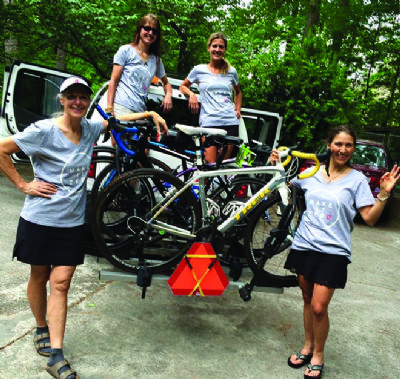
Four women racing 3,000 miles on bicycles in less than eight days: that is my team’s goal as we compete in the Race Across America (RAAM) next month. Teams will leave Oceanside, California on June 20 and arrive in Annapolis, Maryland the following week after traversing deserts, mountains (Rockies and Appalachians), and the Great Plains.
RAAM is one of the most respected and longest running endurance sporting events in the world. Whereas the three great European Grand Tours (e.g., the Tour de France) are stage races, RAAM is one continual stage, similar to a time trial. Once the clock starts, it does not stop until the finish line. RAAM is about 30 percent longer than the Tour de France. Moreover, racers must complete the distance in roughly half the time allowed for the Tour.
My team is the Sorella RAAM Cycling Team. Teammates Korey Gotoo and Jennifer Klein are from Atlanta, and teammate Lauren Schrichten is from California. We are racing under the umbrella of Sorella, one of the largest women’s cycling organizations in the Southeast. We will be one of four four-person, all-women teams competing in RAAM. RAAM participants can be solo racers or teams of two, four, or eight. Teams can be all men, all women, or coed.
Additionally, we have a crew of about 12 people, led by crew chief Brigette Killion, who will drive support vehicles, navigate, feed us, wash our clothes, massage our sore muscles, and generally make sure that our only job is to ride hard.
How in the world did I get myself involved with this incredible adventure? I’ve been riding seriously for about 20 years, including racing and ultra-cycling events in the past five or so years. Last August a mutual friend introduced me to Korey, recruiting me for the RAAM team that Korey was organizing. RAAM has been Korey’s dream for several years. Although this is not something that I aspired to on my own, I am so excited to have the chance to be part of RAAM!
Training
I already had a good foundation of base miles when I joined my team. I have done at least one ride of 100 or more miles every month for the past two and one-half years, and I typically ride about 8,000 miles per year. RAAM training is about more than just logging a lot of miles, however. The race strategy for a four-person team also requires intensity.
When I first joined my team, I assumed we would each take racing shifts of maybe four to six hours. That’s not the best way to maximize speed, though. Instead, the four of us will work in pairs, with the two pairs alternating shifts of four hours. When my partner and I are racing a shift, she and I will alternate back and forth, each racing about 30 minutes. Then, we will rest for four hours while the other pair works. (A large part of RAAM is managing sleep deprivation!) Because of this racing strategy, my two RAAM training goals are somewhat at odds with each other: riding lots of miles and doing interval training.
I made a daily training schedule for myself that started January 1. Each month I have increased my mileage goals, beginning with 150 miles per week in January to about 550 miles per week in May. Although I don’t ride the designated number of miles every single week because of other life commitments, I’ve definitely been trending upward on my mileage, and I’ve stuck to my schedule. RAAM takes dedication; I feel like I have a part-time job on top of my full-time job!
To mimic the on/off nature of how we’ll race, I have done several training sessions that I call RAAM blocks. I ride a 20-mile loop from my house and then rest for 30 minutes. (Actually, I fold laundry or wash dishes during those 30 minutes; these days I have to take any opportunity to do a little housework!) Then, I ride another 20 miles and rest another 30 minutes, repeating this for up to 100 miles. During each block I ride, I try to maintain about 70 percent of my threshold power. Threshold power is the maximum power (wattage) a person can maintain for one hour. I know what my threshold is from prior testing and racing. It’s been interesting to experiment on myself to determine the power level I can replicate over and over during these intervals.
Fueling is another big piece of the training puzzle. On rides of 100 or more miles, I need to eat something about every 1½ hours. Some of my typical bike foods are Clif Bars, fruit, and trail mix.
Protein is important on such long rides, too. I might carry a sandwich (turkey, pb & j, or even pimento cheese on cold days), hard boiled eggs, or sardines. Yes, sardines! My cycling friends and I laugh about it, but they are a great protein source, and I really do like them. My favorites are the ones in Louisiana hot sauce.
On rides up to about 50 miles, I usually just drink water. On longer rides I use electrolyte drinks, starting with Heed (a mix that I purchase on-line) and supplementing with Gatorade or Powerade from convenience stores. At the end of a long ride, I make a recovery drink that’s essentially glorified chocolate milk: milk, chocolate syrup, chocolate chips, ice, and a scoop of protein powder.
One of us will be on the road 24 hours a day during RAAM, and we potentially will race through all kinds of conditions: desert heat, mountain cold, or rain, for example. Therefore, I have made a point to train in less-than-optimal conditions. With its abundance of dirt roads, Jasper County is actually quite conducive to nighttime riding (with bicycle lights, of course). Over the winter it seems like it was always cold, dark, and/or raining when I rode. In February I even did a 400K (253-mile) ride that started at 6 a.m. and finished at 3 a.m. I don’t think I’ve ever been so cold, tired, and wet! At least all of that yucky winter weather has made the wonderful warm, sunny days in recent weeks even more delightful.
I have learned a great deal about another important aspect of training: recovery. This is the first time I have ever trained hard enough that recovery is crucial. As I really started ramping up my mileage in March, I decided to start riding at an easier pace on weekdays, leaving my harder efforts for the weekends when I ride longer. In addition, several weekends ago I had planned to ride a few hundred miles, but I modified that to a recovery weekend (50 miles Saturday and 50 miles Sunday) when I realized that I needed more rest. My training schedule also includes a week or two of tapering, when I will ride only 100-200 miles per week right before RAAM begins.
Logistics and Team Dynamics
As important as training is, the logistics of RAAM are just as critical. RAAM provides the rules and basic structure, but we have to organize our own race. Some of the bigger tasks include recruiting and training crew members, arranging the RV and two minivans that will follow us across the country, gathering bicycle gear and other necessary equipment, and making travel and lodging arrangements for the start and finish. We won’t stay in motels along the way; we’ll sleep in the RV, constantly moving forward. My team is fortunate that several of us have prior RAAM experience. Lauren has raced on teams twice before, Korey has crewed, and Brigette has raced and crewed.
This past weekend we did a mini RAAM. Lauren flew here from California, and we practiced rider exchanges within four-hour blocks, according to our race strategy. Our crew also got some valuable experience in their support roles. The main thing I learned, however, is that RAAM is not only about being physically prepared. The social aspect is just as central to RAAM. I’m glad that Jennifer, Korey, Lauren, and I could finally all spend some time together as a team. Now I have a much better understanding of how we can work together to reach our common goal of racing across America.
Charity Partner
As a team of women, we want to encourage and empower other women. We even have a mission statement:
Our mission is to help women and girls realize their potential and bring lasting change in their lives in an emotional, physical, and productive way. The purpose of this life-changing event is to unify women of all cultural backgrounds and transform our lives so we can give our best to our families and community. We are stronger together and when united in love.
Most RAAM participants race on behalf of a charity, and our Sorella RAAM team is no different. We are partnering with Wellspring Living, an organization in Atlanta that helps victims of domestic minor sex trafficking. This is a serious problem that too often gets overlooked. My Sorella RAAM team hopes to raise awareness of what Wellspring Living is doing to help these young women recover and move forward with confidence. We are glad to have this connection through Jennifer, who has volunteered with Wellspring Living through her church. Any funds that we raise above our races expenses will go to Wellspring Living.
For more information about my team, RAAM, or Wellspring Living, please visit www.sorellaraam.net, www.raceacrossamerica.org, or www.wellspringliving.org. Also, please follow us on Facebook (Sorella RAAM 2015). During RAAM you can even track us in real time. Thank you for your support – ride on!