The Cards Visit Lebanon
My name is Peter Card. I am currently teaching and living in Al Ain, Abu Dhabi in the United Arab Emirates (UAE). This is the eleventh correspondence to share my adventures living abroad. I am truly amazed at where life has taken me. I hope by sharing my experiences it encourages you to pursue your dreams as well. God Bless!
I really thought that our (my wife Cheryl and I) next adventure would not be until National Day at the start of December but a one day holiday landed at the end of a weekend and I couldn’t resist the opportunity to explore. I was looking for a place near, but I thought I had exhausted most of the international cities within five hours. A colleague suggested Beirut, Lebanon and my initial thought was my memories of car bombings many years ago. After much research, I found that while many are still fearful of travel to Beirut because of its shared border with Syria, Beirut is a thriving, spectacular city with much to see and do.
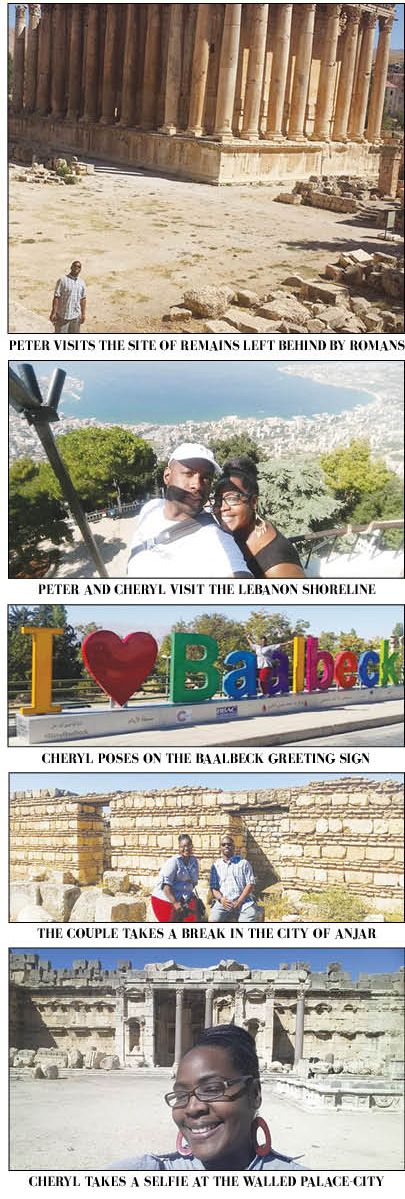
In places where the driving is suspect, we tend to use tour companies and Lebanon definitely fits this rule. At least five times during our stay the driver went the wrong way on a road on purpose. It is amazing how traffic laws are more like advise in many places. Nevertheless, we arrived safely at every location. He was actually a great driver. Our first destination was Anjar. This was a walled palace-city built in the 7th century. The remains of houses, stores, thrones and bathhouses give a glimpse into what life was like thousands of years ago.
Our second stop and by far the most amazing was Baalbek. According to our wonderful tour guide, when a conquering nation came upon an important religious or tactical site, it often built its own religious site on top of the same location. Baalbek literally means the valley of Baal, the oft-mentioned god of the warring people in the Bible. The Romans expanded upon this site with several brilliant temples that are arguably the most preserved remains of Roman temples in the world. The size and scope of the temples are astounding.
The next day took us to Jeitta Grotto. Inside caves at the foot of the mountains, acid rain soaks into the ground and creates limestone stalactites and stalagmites. Going through the caves is like viewing something from another planet. The first cave tour is by foot and it is spectacular, but the second tour is by boat. The ground water that soaks through eventually is filtered through the rock and the caves become underground lakes with crystal clear water. It was one of the most memorable experiences during our travels.
Our next stop was Bylbos. Like many other places in Lebanon, many civilizations saw the value of this spot and built here. It is believed that as many as nineteen different civilizations occupied this coastal area. The remains of a castle are still intact built from stones of previous buildings.
The rest of our time we spent in the city of Beirut, a worthy destination all its own. The city sits at the coastline of Lebanon and we walked quite a distance of it. Many people walked along the corniche both day and night. Pigeon Rock, a natural land mass off the coastline is a favorite stop for photos. We took a cable car to the top of the mountain that sits at the base of Beirut to Harisa where we observed a church and statue dedicated to the Virgin Mary. Both Christians and Muslims live side by side in Lebanon.
While Beirut was never on my radar of places to travel, I am definitely glad I had the chance to experience this wonderful country.
If you would like to hear or see more of my adventures, you may look for Peter Card in the UAE on Youtube or the Peter Card Facebook page. Feel free to leave a question or comment at either of these places or email me at cardsimon@hotmail.com.