The ‘Twin’ Schools: A History From Equalization to Integration
(Editor’s Note: Our coverage of Black History Month continues this week as 2007 Jasper County High School graduate Coddy Carter has submitted this piece. It will run in more than one part. The first part follows.)
By CODDY CARTER
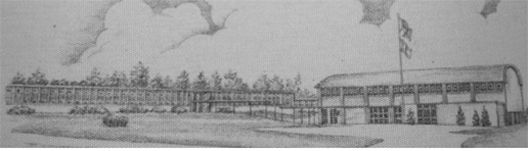
Looking at the gymnasiums for both the former Washington Park Elementary School and the current Jasper County Middle School, the physical similarities are clear. Both schools started operation as Jasper County Training School and Monticello High School, respectively, during the 1956-57 school year.
Jasper County Training School housed black students from grades one through 12, while white students in secondary grades attended Monticello High School. The physical appearances and the founding years of the schools were not coincidences. The story behind the schools is one that started long before one brick was laid in the 1950s, and it is one intertwined with the history of education in Georgia.
County Training Schools & The Development Of Public Education
The inscription on the cornerstone marker at the old Washington Park School still reads, “Jasper County Training School.” County training schools were established in rural areas throughout the South with the intention that they would serve as places where black students would be “trained” to occupy their places in society.
Robert C. Ogden, a supporter of early black schools, once stated, “our great problem is to attach the Negro to the soil and prevent his exodus from the country to the city.” The period between 1890 and 1910 also saw the emergence of Booker T. Washington as the founder of Tuskegee Institute and the figurehead of the Hampton-Tuskegee model of education.
The Hampton-Tuskegee curriculum balanced academic subjects with practical fields such as agriculture and carpentry. Washington appealed to philanthropists by using their own words and attaching alternate meanings to them. He once proclaimed, “our greatest danger is that in the leap from slavery to freedom we may overlook the fact that the masses of us are to live by the productions of our hands.”
Washington intended it to mean that students could make a living even if they chose not to attend college, but financial supporters interpreted his statement as encouraging blacks to be in subservient positions. Washington believed that learning practical trades would allow students to one day be able to purchase their own farms, sell their own crops, build homes in their communities, and start business rather than being limited to menial jobs in factories or sharecropping.
The building of most county training schools across the South was the result of the Rosenwald School Building Program. Julius Rosenwald, the namesake for the fund, had been spurred to start supporting black schools by Booker T. Washington. It started when Rosenwald gave a gift of $25,000 to Tuskegee Institute and an additional $12,000 to build local schools near Tuskegee.
After those initial gifts, he wanted to support other rural schools that would eventually supply Tuskegee and similar institutions with their student bodies. Rosenwald had one requirement before supporting a school: he would only provide money if local black communities matched his contribution. No matter the obstacles placed in front of them by philanthropists or the intended purposes of county training schools, the black community of Jasper County raised enough money to ensure that Jasper County Training School would be a place where children would be educated and not trained.
Despite lacking the comparative wealth held by the white community, Jasper County’s black citizens raised the bulk of the money to build Jasper County Training School. At a total cost of $8,000, blacks provided the bulk of the funds at $4,200, while $2,200 came from taxes, and Rosenwald Fund provided $1,600.
They not only matched the contribution of the Rosenwald Fund but almost tripled it. Whereas the state average for black community fund raising across the state of Georgia was 18 percent, the collective of black people in Jasper County put up 54 percent of the building fund.
A testament of their commitment to education, the children and grandchildren of slaves pieced together money and old materials from the former Monticello Academy/High School to build a school that would educate their own children and grandchildren. Even if that meant those children would one day leave Monticello for opportunities elsewhere, they would at least be armed with the education to pursue those prospects.
At the time when Jasper County Training School was built in 1921, college and any education beyond eighth grade was a long shot for blacks in rural Georgia. At the time, 122 public high schools served white students in Georgia while none existed for their black peers.
Black students wishing to further their education from Monticello and surrounding rural areas had to travel to either Macon, Fort Valley, or Atlanta. Ballard, Lewis, and Hudson high schools were located in Macon.
To Be Continued Next Week