What Are Microfluidic Systems Used For?
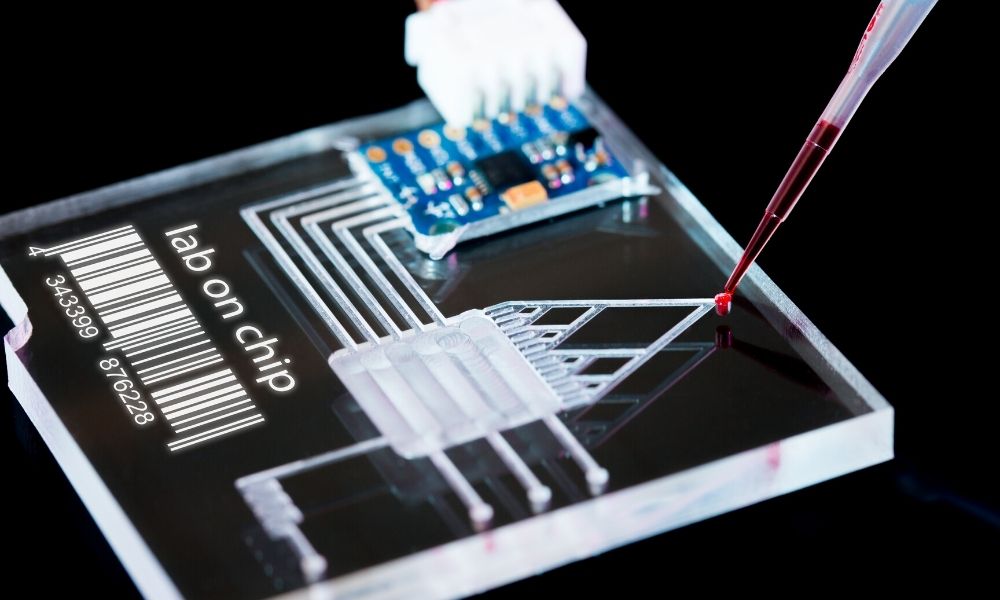
Microfluidics is the study of systems that can process small amounts of fluids by using tiny channels with microscale dimensions. That means invisible to the naked eye. The liquid quantities are usually in the tens to hundreds of micrometers. Microfluidics is emerging as a breakthrough technology even though it’s in the infancy stage now. Diverse applications across many fields are emerging, from biology and chemistry to information technology and optics. Let’s find out what microfluidic systems are used for.
Microfluidics and Photolithography
Microfluidic systems are made using a simple technique called photolithography, which was originally developed for making small features on circuits in the semiconductor field. The process involves transferring geometric shapes present on a mask to a suitable substrate. Special polymers react to specific wavelengths of light to create the desired patterns on the substrate. In the case of circuits and microchips, the substrate is usually a plastic polymer like polydimethylsiloxane. Microfluidic systems have replaced silicon and glass as the preferred platform for microchips and are widely used in the production of microfluidic devices.
Uses for Microfluidic Systems
Uses for microfluidic systems are on the rise, and scientists and engineers are finding new applications all the time. Medical research applications of microfluidics are mainly in the study of antibiotic drug-resistant bacteria, nanoparticle transport in blood, and observation of the chemical reaction in kinetics.
Diagnostic uses of microfluidics include cancer and pathogen detection. Microfluidic devices are used to measure molecular diffusion coefficients, fluid viscosity, and chemical-binding coefficients.
Microfluidic systems are widely used in procedures such as capillary electrophoresis, isoelectric focusing, immunoassays, flow cytometry, sample injection in mass spectrometry, PCR amplification, DNA analysis, separation and manipulation of cells, and cell patterning. In the pharmaceutical industry, microfluidic systems have many analytical uses in biopharmaceutical production. The process is used in the monitoring and optimization of protein drug production and assays involving human cells.
What Is the Future of Microfluidics?
The sky is the limit as there are many advantages to utilizing microfluidic systems, among them the development of more sophisticated technologies for manufacturing industries. This urgent need will continue to promote the commercialization of microfluidics and push it to the forefront of manufacturing. As more information on the process filters into the manufacturing and medical worlds, the demand for it will continue to grow.