How Disposable Diapers Are Made
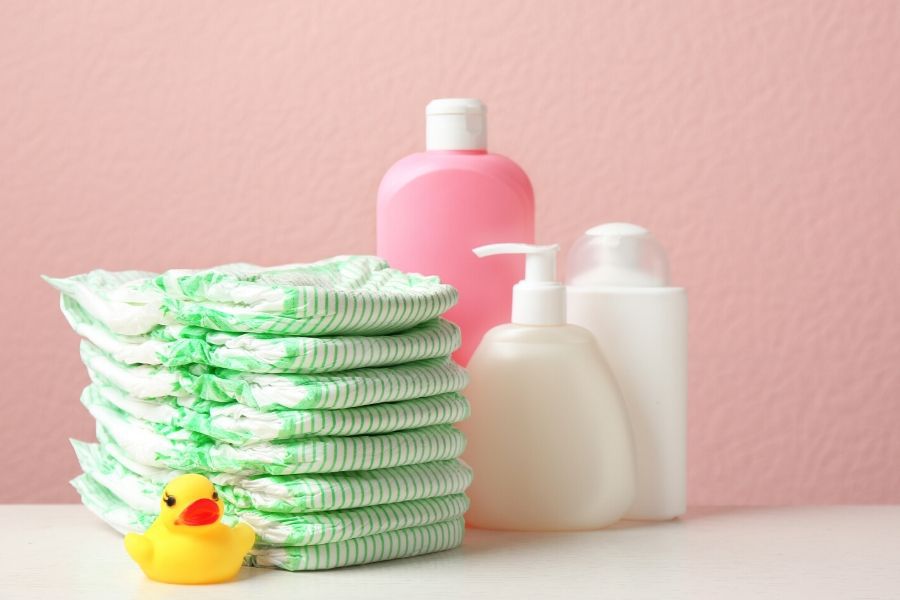
Disposable diapers have a notable reputation. After all, they’re used to absorb your baby’s messes and prevent it from spreading. They are a staple for any baby bag in any situation. Knowing how disposable diapers are made is equally important so you know what you’re buying. Ultimately, disposable diapers consist of two parts: the absorbent pad and the nonwoven fabric. Both are an essential component to keeping your baby covered and preventing messes.
Forming the Absorbent Pad
- A movable conveyer belt passes through a long forming chamber where pressurized nozzles spray fibrous materials onto the surface. The bottom of the conveyer belt perforates, and a vacuum pulls the fibers down to form a flat pad.
- Absorbent material is applied onto the pad’s top surface after it has been formed. This approach sometimes causes blocking in which moisture gets trapped in the outer layer and doesn’t diffuse to the center. This will hold moistures against the skin and cause discomfort.
- Multiple spray dispensers apply several layers of polymer and fiber to the pad. Once the fiber is drawn to the center and the bottom pad forms, the polymer is added to the mix to form a layer of combined polymer and fiber. This creates an absorbent polymer pad at the center with fibrous materials surrounding it.
- The pad then proceeds down the conveyer belt to a leveling roller near the outlet of the forming chamber. The level roller removes part of the fiber at the top of the pad to ensure a uniform thickness. The pad then continues along the conveyer belt.
Forming the Nonwoven Fabric
- When it comes to nonwoven applications, manufacturers can use web guiding systems and their corresponding components to make their products quickly and efficiently. Plastic resin from the meltdown process forms nonwoven fabric sheets, and the guiding system’s wide web rolls cut the fabric to the appropriate width. This process occurs for both the top and bottom sheets. It’s important to note the nonwoven sheets form in a different location than the pads, so this step doesn’t necessarily occur after pad formation.
- Stretched elastic bands attach to the backing sheet with an adhesive. These bands contract and gather together to ensure a snug fit and maintain leakage.
Assembling the Components
- At this stage, there are the three main diaper parts: the absorbent pad, the top sheet, and the bottom sheet. To align them in place, the absorbent pad and bottom sheet go through a conveyor belt. The top sheet is fed into place, and the compiled pieces are glued, heated, or ultrasonically welded into place. These come out as a long strip or roll.
- The long roll is cut into individual diapers which are then folded and packaged for shipping.