
Trading Snow for Sand
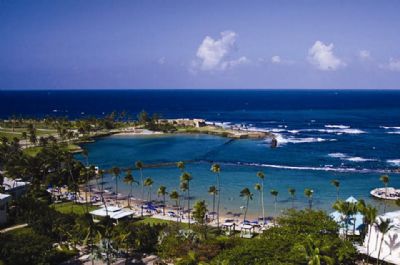
During the week of January 10, Elizabeth Davis, Judy Nelson, Melissa Harvey, and Lindsey Sosebee traveled to San Juan, Puerto Rico, a U.S. territory since 1898.
Both Ms. Davis and Ms. Nelson attended a teacher’s convention hosted by Explorica Educational Travel headquartered in Boston, Mass.
Explorica is the travel company Piedmont Academy uses every two years to take groups around the world and within the United States. A group of 45 from Piedmont will travel to New York and Washington, D.C. in March.
When the travelers arrived in San Juan, they encountered an 85 degree temperature, sunny skies, and a tropical breeze.
As they became familiar with the hotel property, from their balcony they saw two 500 year old forts on either side with the white crest of waves splashing the fort walls from a deep blue and aqua Caribbean sea.
On the eastern side of the property, they discovered two large koi ponds with water fountains and a pair of black and white swans patrolling the calm water as well as a pair of peacocks guarding the garden area. The fish measured 1 to 1.5 feet each and they gave the guests quite a show as they whisked through their tranquil waters. A view of the infinity pool overlooking the ocean could also be seen.
The locals were very excited about a festival to begin that week. The festival of Saint Sebastian celebrated the end of the Christmas season and the beginning of the new year. Puerto Ricans have the only country to celebrate Christmas for almost two months of the year.
{{more}}
After a taxi ride to the first plaza of historic Old San Juan, Christmas decorations lined the streets and trees. At the first plaza was a granite statue of Cristobal Colon, or Christopher Columbus, who found the island in 1493. The celebrations were similar to Mardi Gras hosted in New Orleans. As the week progressed, the streets became more crowded with locals. Music, food, local crafters, artists, and costumes filled the cobblestone streets and restaurants.
The group enjoyed dinner the first night at a restaurant specializing in island cuisine. Mashed plantains, like our mashed potatoes, are a very popular dish. Fish, beef, and pork are commonly served.
The next evening, the travelers enjoyed a delicious dinner at a converted convent, Patio del Nispero at Hotel el Convento.
The old-world charm and splendor of the historic building was built in Spanish Colonial design and architecture and the building was directly across the street from the San Juan Cathedral, the Western Hemisphere’s oldest cathedral which houses the remains of the explorer Ponce de Leon. The Carmelite convent, petitioned by King Phillip of Spain, was in operation from 1646 to 1903.
In 1956, the property was purchased by R.F. Woolworth as part of the U.S. social welfare program in the 1940’s named “Operation Bootstrap.” The property was converted into a hotel, open-air patio, and restaurant.
The chef at the restaurant had recently been voted as one of Puerto Rico’s top ten chefs and he was proud to show us the write up in the November issue of the magazine, Caras (Faces). It was the first night they had begun serving dinner in five years so it was a very special evening for the hotel and restaurant staff.
The Explorica convention for Davis and Nelson began the next day. The group gathered and enjoyed dinner across from the plaza with the statue of Christopher Columbus.
Educators attending the convention were from Boston, Cape Cod, Los Vegas, Tulsa, Houston, Philadelphia, Lexington, Ann Arbor, Richmond, Baltimore, Miami, Atlanta, Canada, and a small town in South Dakota. Some taught history, drama, music, Spanish and French. They shared their experiences of traveling with students and ways to improve group travel.
Their first excursion was a walking tour of Old San Juan. The stucco town-houses, shops, and restaurants were painted in a variety of colors from shades of gold, green, pink, purple, and periwinkle blue.
They had balconies overlooking the narrow cobblestone streets built for carriages. The streets were not actually paved with stones but iron slag. When the English and Spanish were acquiring gold from Puerto Rico, they would take the iron used to build the ships ballast and they would pour the iron waste into the shape of gold bullion squares to be used as pavers.
The Pablo Casals Museum gave insight to the Indian tribes that lived in Puerto Rico prior to the Spaniards arriving. Artifact displays of the Archaic (5,000 B.C.) groups who were semi-nomad and lived in caves were on display. They moved to where food was plentiful near mangroves and river mouths, and they studied the migration of birds.
The Saladoid culture (430 B.C.E.) lived in villages and built communal huts with straw roofs that housed several families. The Ostionolde culture (600 A.D.) improved the use of shells for tools and utensils. The final aborigines tribe, the Taino (1200 A.D.) were excellent carvers of stone and wood. They also introduced the use of various drums for ceremonies and celebrations.
Afterwards, the group visited El Morro Fortress. Three flags flew on top of the fort: the flag of the United States, Puerto Rico, and the Burgundy Cross, the Spanish military flag. On the top floor of the fort, narrow trenches ran along the walls to collect rain water. Since there was no fresh water source near the fort, the soldiers collected rain water to drink, cook and wash. No animals were allowed on the top floor for fear of contaminating the drinking water collected.
In 1625, the Dutch captured El Morro for about a month and they used animals to transport mortar and cannons to the top of the fort. The animals, since they were housed on the top floor, did contaminate the water and thousands of soldiers died. The fort was believed to be haunted and cursed for many, many years. Looking out beyond the fort, one would see a small island. A hospital was built on the Isla de Cabras in the 1876 to isolate people sick with leprosy. These individuals were exiled for life to a remote place.
On the walk to San Cristobal Fort, the group saw a community, La Perla. The main part of the city of San Juan is surrounded by a wall built by the Spaniards, but this community lies between the wall and the sea. Animals were housed there for centuries and thus, a community was developed.
There is tremendous loyalty to this community and land developer, Donald Trump, tried to purchase the property to build a resort but the locals would not sell. The guide told us it was a dangerous area with drugs and gangs but a lot of famous baseball players grew up in this area of San Juan.
Similar in size and structure to El Morro, San Cristobal Fort allowed the group to walk down to the bottom floor to the dungeon. Soldiers and citizens of Puerto Rico were thrown into the dungeon if they had broken the law or if they were not loyal to the Spanish government.
The dungeon was a long, narrow hallway and extremely humid. As the group was admiring the drawings of ships and stories drawn on the stone walls, the guide turned off the lights to show us the true atmosphere of the prison hallway. The area became pitch black. To say the least, everyone wanted to exit quickly!
The next day proved to be quite adventurous as the group traveled approximately 30 miles to El Yunque Rain Forest. Maintained by the US Dept. of Interior, the 28,000 acre tropical forest hosts a number of unique plant and animal species such as the endangered Puerto Rican Parrot and the tiny coquis, 1” indigenous brown tree frogs, who serenade the evening hours. The forest receives over 100 billion gallons of rainwater fall each year.
On our tour, our guide pointed out to us when we came across a rare, yellow land snail (polydontes acutangula) that is seldom seen in the forest. The group hiked a forty-five minute trail to view one of many waterfalls in the forest named “La Mina Fall,” and several of the travelers swam under the 35’ waterfall in some rather frigid rushing water. Along the hike, every imaginable color of green was found in the dense forest and exotic flora.
The next destination was Luquillo Beach. Here, you could see the mountains of the rain forest and watch the rain falling on the mountains, yet be dry at the beach. Several enjoyed a frozen treat made with mango, coconut, lemon, and raspberry syrup named piragua. Luquillo Beach is said to be one of Puerto Rico’s most beautiful beaches.
The group traveled to the north eastern tip of the island to take an evening kayak adventure in the fishing village of Fajardo for a bioluminescent bay excursion. After four marine biologists gave a brief kayak lesson, they boarded their two-man kayaks and paddled from the open waters, through a canal which fed into Las Crobas Lagoon.
The canal and lagoon were lined by red mango trees. The iguanas climbing the trees probably had a good laugh as they watched the kayaks steer against the ocean current into the lagoon. This is the only lagoon in the world to have bioluminescent plankton year-round.
Five other locations in the world have this feature but for only a short amount of time during the year. The lagoon contains 5-700,000 plankton per gallon and when disturbed they light up. When you place your paddle in the water it triggers the plankton to emit a light. If you splash water on your legs, it looks like tiny stars or fairy dust for one or two seconds. The two-hour adventure was quite amazing.
Overall, the travelers found the island to be very friendly, clean, and a family-oriented destination. Popular attractions include snorkeling, diving, fishing, windsurfing, golfing, and horseback riding. When the group’s plane landed in Atlanta, they could not believe snow/ice was still on the ground after six days.
According to Hilton Hotels, “travel is more than just A to B; travel should refresh your spirit.”
To say the least, the traveler’s spirits had been refreshed at a tropical paradise in the middle of January.