Do Wild Populations of Big Cats Still Roam the Wild’s of Georgia
Over the past several weeks the readers of The Monticello News have been well-saturated with op-eds about our local elected officials and from our local elected officials, mainly addressing whether or not Jack Bernard is a jerk or whether or not his “CAVE” people are the problem.
It has been an entertaining read, but I doubt I stand alone in saying that the bickering is getting a bit tiresome. So, in an effort to provide fodder for novel op-eds that will hopefully steal ink away from those wanting to continue the political back and forth, I’m going to try ginning-up a new controversy.
Do wild populations of big cats still roam the wilds of Georgia?
By “big cats” I mean those species whose individuals are consistently larger than a bobcat. There is no doubt that bobcat populations are found throughout our state, most populations being quite healthy and large.
Hunters kill them, photographers snap pictures of them, and vehicles crash into them. Proof abounds. However, proof is very scant, nearly non-existent, for the panthers, cougars, mountain lions, and pumas (all common names for the same species) that are commonly reported from Georgia.
The eastern cougar and the Florida panther are two different subspecies of the same species, and taken together, this species historically roamed our entire state.
The last confirmed wild Florida panther was killed in the Okefenokee Swamp in 1925, the last eastern cougar before that. Populations of the latter survived in the mountains of North Carolina and West Virginia until perhaps the 1970s, but existing wild populations are thought to occur no closer to Georgia than western Oklahoma and Texas.
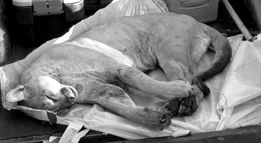
The story of the Florida panther in Georgia has been muddied somewhat in recent years, though, with the confirmation of one individual male shot by a deer hunter in Troup County in November of 2008. The carcass of this big cat was brought to my office in Forsyth and I was fortunate to get to see it, although I would have much preferred to see it alive. I felt its soft pelt, I handled its enormous paws, and I was impressed by its formidable teeth.
There was no doubt what species it was, but from our office it was sent to a wildlife laboratory where its subspecies was confirmed by genetic testing.
Reported sightings of black panthers in Georgia are common, but I don’t consider any of them valid. The black panther is actually a rare color morph of the jaguar, a species that naturally occurs only in Central and South America. Black panther “sightings” in Georgia and elsewhere in the United States are most likely attributable to otters, black bears, black housecats, black labs, or way too many Budweisers.
But, sightings of “tan” panthers probably deserve a little more attention now that we know one animal has been confirmed from the state. Even so, most biologists in Georgia agree that if there is any validity to sightings of tan-colored big cats, they are more likely to be released or escaped pets than from a wild source.
Believe it or not, some folks keep mountain lions and cougars as pets, and in adjacent Alabama it is perfectly legal to do so. These enormous kitty cats are obviously a real load to take care of and their groceries can be quite expensive. As a result, many unprepared owners eventually release them to the wild, and confirmed, previously-pet cougars are occasionally found.
The Troup County panther was genetically confirmed to be a Florida panther and it is known through radio-telemetry studies that young males will occasionally travel from extreme southern Florida to the Panhandle. Thus, 100 more miles or so of travel to west-central Georgia is not that unbelievable. What is almost unbelievable, though, is that a cat moving hundreds of miles through the buggy woods of Florida and southern Georgia would be virtually devoid of external parasites, such as ticks and fleas, but that was indeed the case for the Troup County panther.
Further, the pads on the animal’s feet were scuffed-up in manner suggesting it had paced back and forth on a concrete floor, which is typical of captive cats. Therefore, it being a released or escaped pet is well within reason and may be more reasonable than believing it was actually a wild cat. In actuality, we’ll probably never know the true origin of that particular cat.
An occasional individual, like the Troup County panther, occurring in Georgia is one thing, but a population of them is another. I contend there cannot be a population of big cats in Georgia or else we would have more proof.
The south Florida panther population numbers near only 100 individuals, yet roadkills and photo-confirmations of them are made every year.
That population is hovering right at a genetic bottleneck so that if the population drops much lower it will become too inbred to survive. If we have 100 or more of them in Georgia they should be as “easy” to confirm as S. Florida panthers. If we had less, their genetic diversity would be too low for them to persist.
In 1993-1994, eleven female and nine vasectomized male western cougars were fitted with radio collars and released in northern Florida near the Okefenokee Swamp to see if an experimental population of Florida panthers (using the more common western subspecies as a surrogate) would be capable of surviving in that area.
These cats moved great distances, one even coming all the way up to Wilkes County, but two were shot and two others were hit on roads. Out of 20 released cats, four became carcasses that provided clear proof of their existence. If we had a natural, wild population, don’t you think we would have greater evidence?