German POW Camp in Monticello
In 1941 World War II was in full swing in Europe. Adolph Hitler had led the German Army through Poland, Czechoslovakia and France and had pushed the last British off into the English Channel at Dunkirk. We in the USA were slow entering the war but finally after the Japanese attacked us at Pearl Harbor we became involved on both fronts.
Prior to this we had supplied the British with all sorts of war equipment and arms to help them defend themselves. We were ill-prepared for war but at this time had no other choice. However, we prepared fast.
Our first real offensive was in North Africa where General Romell, ”The Desert Fox,” was in full control. Under the leadership of General Eisenhower our troops landed in North Africa and proceeded along the coast of the Mediterranean Sea and finally invaded Sicily and Italy. The Germans were in control of all of these fronts but thanks to General Patton and his Tank Force we moved very quickly on through Italy.
When Armies invade they usually pick up a lot of military prisoners along the way and we were no exception. We had the German prisoners but holding them was a problem. We needed all of our troops to fight and had no time to set up prison camps on foreign soil along the way and deplete our troop strength.
Therefore, thousands of German prisoners were grouped at certain seaports and reloaded on troop ships that had arrived with fresh U.S. troops, and then returned the prisoners to the USA. This worked fine. Upon arrival in the USA they were assembled, processed and shipped out to small prison camps in the Southern USA. Most were captured during the African campaign.
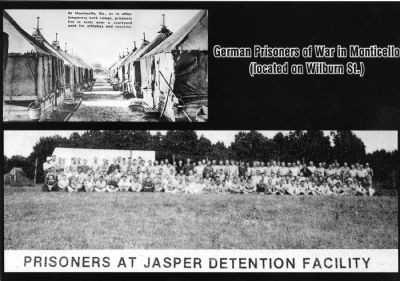
As noted in the picture above, a German POW camp was established in Monticello along with about 50 others throughout the south. The southern states and small towns were selected because of warmer weather for the camps and in a rural area that could be controlled better.
There were over 400,000 German prisoners returned to the U.S. in 1942. The Army abided by all the rules of the Geneva Convention and fed and treated the prisoners about the same as our own soldiers. This was to make sure that our enemies treated our prisoners the same. That was not always true of our enemies.
The Monticello POW camp was established where the Jasper Middle School is now, on the old Wilburn farm grounds. The camp was directly across the street (Post Road) from Edgewood. The living quarters were old Army tents on wooden floors that held about five men each. We had over 160 prisoners and thus 35 tent shelters including the guard’s tents. These tents had been used in maneuvers prior to WWII and were put to a good use. There was also a mess hall, latrine and recreation area. We had about a Company of Army guards there at all times. These were mostly Limited Services troops that could not serve in combat areas.
No fences were needed at the compound, they were all glad to be here instead of on the Russian front. My good friend, C.T. Pope, was an MP during the war told me about transporting our troops over to France and then loading out German prisoners to bring home on the same ship. When loading, he said the Army furnished him an empty shotgun but even that was not needed as hundreds of the prisoners rushed to the ship to board and leave, they were happy to leave Europe.
Most of the prisoners were skilled and made furniture and other items. Locals could get work details to help pick peaches and work in the logging business or on farms. Marilyn May Allen furnished me letters received by her Dad, a lumberman in Jackson, who worked prisoners.
By her letters, they all wanted to come back over here after their release in France. Most were released and returned to Germany in 1946 to be discharged there but times were hard there and they could not find work or food for their families. They had no love for the “Third Reich” who got them into this mess in the first place.
It is said that the local camp was a very interesting place and all the prisoners were orderly and friendly and kept the place spotless. It is said that in some camps prisoners tried to escape but with no money or directions or help and not speaking our language they only got a short ways and then returned to camp. None tried to escape from the Monticello facility.
The POW camp was completely dismantled in 1946 after the war ended thus ending another chapter in Monticello history.