Blacksmithing
Under a spreading chestnut-tree
The village smithy stands;
The smith, a mighty man is he,
With large and sinewy hands;
And the muscles of his brawny arms
Are strong as iron bands.
I’m sure we all remember this great old poem by Longfellow in 1841 which helped preserve the image of a craftsman who symbolized the horse and buggy era of America.
Believe it or not, blacksmithing goes back a very long way. History says it goes back to about 2000 B.C., long before Christ was born. Even before this time man only had rock and wood to work with. These tools were heavy and the wood would break often. They did not work well for weapons of war.
Our early Indian tribes had only rock and wood for their spears and arrows and there was no iron or steel in their environment.
Things progressed and iron ore was discovered in great supply in China and England and really all over the world. The Syrians and Egyptians are believed to have known of iron and its manipulation about as early as the Chinese.
They found that this ore could be heated, melted and cooled into a hardened iron form. It could be carbonized to hold sharp edges on swords. The great forest furnished all the wood they needed for charcoal to heat the ore.
Immediately the skilled blacksmith came into the picture. He was probably the most sought after artisan of his time because he could forge the hardened iron into many forms. He made swords and spears with very sharp edges that could hold up under battle conditions. He also made armor for the warrior including breastplates and helmets and even armor for their horses. He even made certain machines and stoves of that era. Also nails for house building.
He worked on the great sailing vessels and made them ready for the long voyages. Horses were the main war animals of that time and they had to have shoes to help them run on rocky ground. In general, everything centered around the popular blacksmith and his work. Not only did he make weapons for war but he made hinges for doors and lots of cook ware.
Nearly every community had several blacksmiths. When the Englishmen traveled to many foreign lands during the Crusades they took along blacksmiths to help maintain their armies.
Early after our great country was discovered blacksmiths appeared on the scene. It is said that nearly every great ship filled with immigrants that landed in the harbors contained several blacksmiths.
Early wrought iron had to be shipped from England and the cost was high. Also, the weight of iron sunk many vessels not equipped to haul such weight. Immediately ore was discovered in the northeast in great supply. Again, great forests provided the wood necessary for heat in the foundries to smelt and produce the finished wrought iron.
One of our great early blacksmiths was a man by the name of John Deere. He grew up in the northeast but later moved west and developed a plow that held up good on the prairie land. This skill developed into the great farm machine company in Illinois that we know today, John Deere Company.
Nevertheless, the blacksmith, for all practical purposes has vanished. The “farrier” (works with iron) remains. The “farrier” is an offshoot of the blacksmith whereas his specialty is the shoeing of horses. He has no permanent shop. He travels to the site of the horses and tends to all of their hoof needs. He is in great demand around stables and horse shows. Horses are very popular today and even here in Jasper County horse farms are numerous.
There are still blacksmith operations around that make many fine metal objects. Many work with decorators and furnish them with ironwork for expensive homes; items not typically available in supply stores. Morgan Miller has a blacksmith shop in Adgateville and Ivan Bailey has one on Post Road, and they are both very skilled artisans.
I well remember the blacksmiths in Monticello in the early 1930s as well as those in surrounding towns. Bill Maddox had a shop in the alleyway behind the old Chevrolet dealership. He did a lot of work for the farmer on wagons and plows and the like.
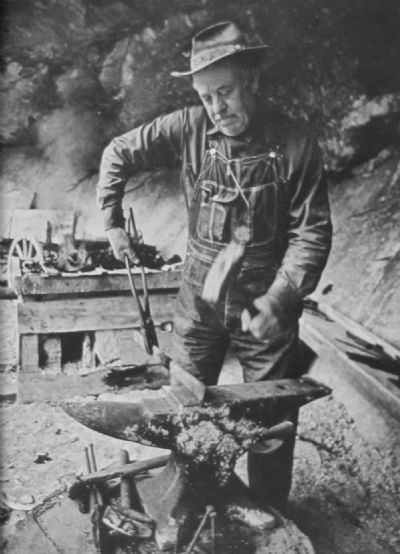
Blacksmith shops were always black from charcoal smoke and the walls were full of tools of his trade. A horse or two was usually tied outside. Horseshoes were usually shipped in, and old, used and worn shoes were deposited in a big pile outside. Wagon repairs were also their speciality.
Most farmers of this time had a small blacksmith shop on their place. Many shoed their own mules and horses and also did minor repairs on farm machinery and household items.
The true “blacksmith” may be gone forever in our society but we should always remember the vital role he filled in the development of our country as well as our world. Without the discovery and skilled use of iron ore where would our world be today?