Growing Up in the Early 1800s
I like to preface all of my stories that start around 1800 with the fact that conditions were pretty plain. There is no electricity, running water, limited doctors, and heat only from a wood stove. Many families in our area grew up under these conditions and I want to tell you about a typical one.
To tell this story properly I have to have known the family. From their great old stories I can relate how they grew up, since they are my kin.
My grandfather, John Benjamin Persons, born in 1857, married Elmira Cornelia Phillips, born in 1860. They set up housekeeping on the old Persons farm now owned by the Camp family on Highway 212 west. Grandma gave birth to nine children, six big boys and three pretty girls. Remember this was in the late 1800s and conditions around childbirth were pretty meager but the kids all survived and lived a great life.
As the family grew up they attended Bethel School, a one room schoolhouse adjacent to Bethel Baptist Church. Each morning Grandma fixed the boys a lunch in a lard pail with a couple of pieces of chicken and a big biscuit or two flavored with good cane syrup. Each morning they headed out to the road to walk to school.
The “Bear” Barnes family lived across the road and had big boys also. It is said that they fought and scuffled all the way to school and home. Grandma noted that their lunch pails were getting all dented up. She later found that the boys fought with their lunch pails on the way to school; she soon put a stop to this.
Friends used to question Grandma, “Ella, you must favor Harvey because you take him in the buggy everywhere you go.” Grandma replied, “No I don’t, but I’m afraid to leave him at home because he may hurt some of the others.”
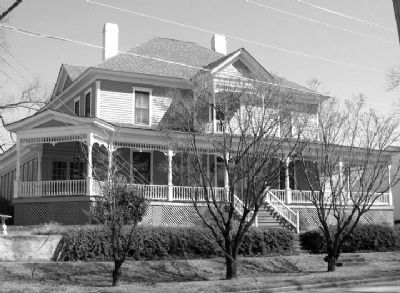
Later, all the older youngsters grew up and started making their own living. Papa and Grandma then moved to town in about 1900, leaving the boys to run the farm, and they built the house pictured above on the corner of College and Washington Street presently owned by the Barksons. It was a big house with about 12 rooms on two floors and a big front porch.
Again, there was no sewage system, so the outhouse was still necessary. This was in the corner of the garden behind the house. To make ends meet, they took in boarders renting the four big upstairs rooms. You know what one hated chore was each morning—picking up and emptying the “slop jars” in the privy and cleaning them out.
Grandma fed all the boarders using the big old wood stove to prepare all the meals. The dining table was usually full and the story goes that Grandma asked Mr. Jones if he needed more tea and his reply was, “No, if Ethel or Finney have to get it,” referring to two young daughters who acted as typical teenagers. Papa was totally blind now from glaucoma and was very little help around the house.
The foregoing were stories told to me, but later on in the early 1930s I could relate better. Every Sunday night in the summer the whole family, with all their kids along, gathered on the front porch in the area jutting out on the left. You could hear this crowd all the way to the Square with their loud tales of the past.
Grandma and Papa, quite old now, usually lay in bed in the bedroom adjacent, listening and laughing until one of the grandkids hit the wall with the swing bringing a loud outburst from her. In the wintertime the group gathered the same night only in the front left corner bedroom where grandma lay in bed and Papa also on his day bed. Every now and then Uncle Howard would “chunk” the coal burning fireplace making everyone move back some.
Stories and local tales were still common. We small ones usually lay around on the floor. Papa chuckled at the old stories being told again. I remember him reaching that long arm out from under the cover and retrieving his “chamber” from under the bed, lifting same back up under the cover and later re-depositing it under the bed again with the family not even noticing.
All of the original family branched out into many fields, Mamie married Chap Benton and moved to Mansfield, J.D. married Fletta White and he traveled selling caskets, Howard married Loveda McGurt and he had a dairy farm, Harvey married Grace Flournoy and he became a prison warden in Hortense, Ray married Laree Spears and operated a funeral home and was once mayor. Carl married Ruth, a teacher, and he became a Putnam rural carrier, and Hugh married Lenna Hawkins and became an insurance salesman. Finney married Hal Lynch and moved to Jacksonville, Fla. and Ethel, my mother, married J.S. Wilson a local cotton ginner.
All the memories and stories were not lost; we put together some great family reunions. This usually consisted of close to 100 kin converging at a given family yard with big tables in the shade and tons of scrumptious food. The reunion lasted all day. Later on I put up my auction tent in our backyard and we personally carried on the tradition for years.
These happy reunion gatherings went on for many years. As families grew larger and lived further away, the reunions finally played out. I love family reunions because they keep families and offspring connected and we tried to keep them going. Later, due to comfort, they tried to have them in church fellowship halls and community buildings, but they lost their flavor and became “less attended.”
I believe every family should have their family reunions to reminisce and remember the past. All reunions should he held in the yard under big shade tress with tables in a long row filled with every kind of food you can imagine with gallons of ice tea in big gallon jugs.
I know we that have gray hair agree with this but we must influence our offspring to continue the reunions to hold future families offspring closer together. In these days, everyone is getting “scattered” all over the country.
Think about it. Be proud of your family and stay in touch and remember the past or it will all fade away with time and be forgotten. I think I’ll try to revive our reunion this year; I hope I can find everyone.