Early Sawmilling in Jasper
When our county was first settled the land was covered with timber of some sort. Landowners had to clear some land for a place to build a house and also had to clear land for farming.
As you might guess, it took a lot of work and planning to accomplish this with the tools they had at hand. A house must have been first on their list so this was where the first type of “sawmilling” began.
The early sawmills were usually very small and required very little labor. Neighbors sometimes banded together to put together some type of lumber operation even though very primitive. Logs were cut with crosscut saws and dragged to the cutting area. The logs were then cut using two man teams who practiced the pit-sawing method.
This method involved, first squaring the logs using axes and then placing the squared log over a pit where two men, one above and one below, would laboriously hand saw boards. This was a slow and hard process that would yield only 100-200 board feet per day but it was very common at that time. Rough boards were sawed this way and used to build the first houses. This method lasted until about the mid 1800s. Even today some old homes have hand hewn sills supporting them.
The greatest improvement in technology for sawmills occurred with the introduction of the “circular saw.” It was invented in England in the early 1800s and finally reached our area in the late 1880s. The introduction of the steam engine into sawmilling operations further increased output and timber production. It is said that the new circular saws were capable of sawing 40,000 board feet of lumber in one day, far exceeding anything done before.
The circular saw in Jasper County was used in sawmilling on up through the 1930s. Later “band saws” came into use. These consisted of a long steel band with sharp teeth rotating at great speed and ripping the boards off the squared logs.
Right after the great depression many farms were abandoned and with the help of the soil bank programs a lot of land was converted to timber. This brought on better timber prices and thus promoted sawmilling to harvest this timber. Sawmills ranged from large operations to small “peckerwood” mills. The investment ranged from a million dollars to a few thousand dollars for the small portable mills, common in our county at that time.
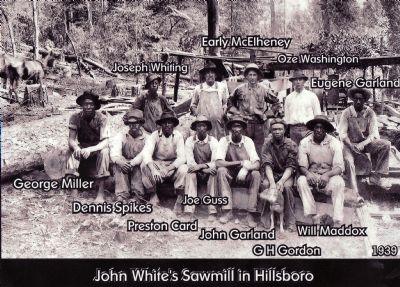
Sawmilling in the 1930s and earlier involved a lot of workers and a lot of mules and horses. The sawmill operation located the timber tract they were to cut on and hewed out a spot for the sawmill. The mill and boiler that powered the mill was moved in with wagons and the operation assembled and ready to start. Workers with cross-cut saws began to drop the timber and limb it up.
Mules were now hooked to the large pine logs and they would pull the log to the mill site making many trips a day. Logs were moved up to the saw table by hand over an incline of logs with “cant hooks.” Mills were usually far back in the county so the crew camped there during the week. A shelter was found or made for the workers and a cook provided for them.
This was a very big operation and a good payroll for the county since each mill worked a large crew and there were many sawmill operations in the county. “Slab” piles for firewood were common around sawmills. I remember the time that you could hear eight or 10 sawmill whistles in the distance each day. This happened on through World War II.
Later big sawmill operations moved to town since moving the mills all around the county and setting them up required a lot of time and money. Now the sawmill was in town so, “Loggers” came into the picture to cut and haul logs from the woods to the central sawmill.
Logging was a whole new operation. The same cutting methods were used but loading the logs on stake trucks and moving them to the mill in town was a big change. This grew fast from the first meager logging operations to much larger ones with the advent of the “chain saw.” Large trailer trucks were introduced and better methods of machine loading were now used. Chain saws cut and “limbed up the logs,” mules pulled the logs in as they were cut and then loaded on log trucks.
Sawmilling and logging have both come a long way today. New machinery was developed for the loggers that replaced the saws and mules. It also increased the investment to the hundreds of thousands of dollars. Several “skidders” and tree cutting machines, plus several large trailer trucks, were now required to get the logs to the sawmill. They can now cut over several hundred acres at a time and in short order.
At present there are no sawmills or planer mills in Jasper County. All of the logs hauled out of the woods go to either Georgia Pacific Plywood Plant or to mills outside our area. There are still many acres of pine trees in our county, some held by private landowners and still more by government properties. We have gone from row cropping to tree farming in Jasper County.