Autumn Is the Best Time of Year to Observe Woodpeckers
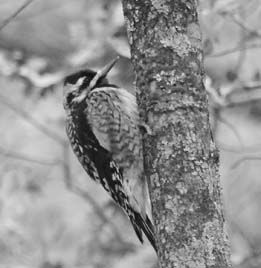
With cooler air upon us and leaves falling from the trees, autumn begins perhaps the best time of the year to observe my favorite bird group—the woodpeckers.
Seven different species of these unique birds can be seen here in Jasper County throughout the year, but fall brings us an eighth species, the yellow-bellied sapsucker, that breeds further north, and also provides us with many more northern flickers than are present at other times of the year.
In addition to the increased species and numbers, fall and winter give us better opportunities to observe these tree-trunk clingers simply because the leaves of hardwoods can no longer shield them from view.
Woodpeckers are fairly unique in the bird world for a number of reasons, first and foremost for their ability to hammer or “drill” into wood to excavate insect prey and build cavities. Most woodpeckers actually build two cavities, one to nest in and a separate one for roosting.
Abandoned cavities are used for nesting and/or shelter by a whole host of other animals, including wood ducks, prothonotary warblers, chickadees, titmice, screech owls, kestrels, bluebirds, flying squirrels, rat snakes, and treefrogs, to name just a few. For this and other reasons, woodpeckers are extremely important in the ecosystem.
Another unique aspect of woodpeckers when compared to most other birds is that they communicate not only through vocalizations, but also by drumming. Drumming consists of fairly rapid pounding of their chisel-shaped bill onto a tree trunk in a species-specific cadence and rhythm. Drumming is much louder than vocalizing and is used to communicate over long distances, either to declare a territory or impress a potential mate.
While all of our woodpecker species have some red on their heads, at least on the males’, only one species, and perhaps our most attractive, truly earns the name red-headed woodpecker. The entire head, nape, neck, and throat of this species looks like it was dipped upside-down in brilliant red dye, with only the black eyes and dark gray bill offering any contrast.
Red-bellied woodpeckers have a bright red band on top of the head and on the nape and are often mistakenly called red-headed woodpeckers, but the side of the head and throat are light gray. As their name implies, they do indeed have red on their belly, but this is rarely seen since it is usually pressed closely to the side of the tree or branch and hidden from view.
Similarly, you don’t often get to see the belly coloration of the yellow-bellied sapsucker, but it does exist. This winter migrant has a really cool feeding strategy that benefits it and other animals. Sapsuckers excavate numerous resin wells in live hardwoods that eventually ooze with tasty sap and trap small insects that stick to it.
These specialized woodpeckers drill the resin wells in a linear fashion so that they appear as very distinctive horizontal rows of small holes, some trees having so many that they appear banded. Sapsuckers and other animals, including other woodpeckers, orioles, hummingbirds, warblers, small mammals, green anoles, and insects, regularly visit these oozing resin wells to lap up the sap and eat trapped bugs.
Arguably the most unique, and certainly the rarest woodpecker in our area, the red-cockaded woodpecker also drills resin wells in trees, but for a totally different reason than sapsuckers do. Red-cockaded woodpeckers are the only species that makes its cavities in live trees, specifically pine trees that are old enough (60+ years) to have soft heartwood resulting from an important, naturally occurring fungus. This species evolved in a wildfire-dependent habitat, and building cavities in live trees better ensures that these shelters will persist for many years.
Every day, usually right after they emerge from their cavity in the morning and again just before they go to bed at dusk, these woodpeckers busily reactivate resin wells to get pine sap dripping all around their cavities, which gives the trees a candlestick look. Pine sap is not tasty (in fact it’s noxious), so they do not do this for feeding purposes, but rather to prevent predators like rat and corn snakes from being able to access their nest cavities.
Despite the seemingly confusing name, if you see a woodpecker with any red on it, you can be almost certain it is NOT a red-cockaded woodpecker. A true “cockade” is but a single feather that adorns dressy mens’ hats. Thus the name of this woodpecker is actually pretty accurate since they only have one or two tiny, red feathers and they are only found on males. Unless they flare-out their head feathers when excited, these red “cockades” are obscured by numerous black and white feathers.
Although it takes a special effort to see red-cockaded woodpeckers (in our area they only occur in a few places on the Oconee National Forest and Piedmont National Wildlife Refuge), all of our other woodpeckers can be spotted in most local woodlots and forests. In addition to those mentioned earlier, these “other” woodpeckers also include downys, hairys, and pileateds.
Most of these woodpeckers are attracted to bird feeders filled with sunflower seeds and/or peanuts, but to really increase your odds of seeing them, consider hanging suet cakes this winter. Hopefully you’ll enjoy watching their interesting antics as much as I do!